In the summer of 1977, NASA launched two spacecraft that would ultimately travel farther than any human-made objects in history. Voyager 1 and Voyager 2 were designed to take advantage of a rare planetary alignment — a once-in-176-years configuration of the outer planets that allowed a single spacecraft to visit multiple worlds on a single trajectory. Nearly five decades later, both probes have crossed the heliopause and are now drifting through interstellar space, still transmitting data to Earth.
The Grand Tour Opportunity
The idea of a "Grand Tour" mission originated with aerospace engineer Gary Flandro, who in 1964 calculated that Jupiter, Saturn, Uranus, and Neptune would line up in a configuration permitting a spacecraft to visit all four using gravitational slingshots — a free trajectory boost from each planet's gravity. This alignment would not recur until the 22nd century.
Contrary to what their names suggest, Voyager 2 actually launched first, on August 20, 1977, while Voyager 1 followed on September 5, 1977. Voyager 1's faster trajectory allowed it to overtake its twin and reach Jupiter and Saturn sooner. Each probe carried a suite of scientific instruments: cameras, magnetometers, plasma detectors, ultraviolet and infrared spectrometers, and cosmic ray detectors.
A Solar System Transformed by Discovery
Before Voyager, the outer solar system was a collection of blurry telescope images and educated guesses. The probes changed that permanently. As Voyager 1 approached Jupiter in March 1979, scientists discovered something extraordinary: active volcanoes erupting on Io, one of Jupiter's moons. It was the first time volcanic activity had been observed on any world other than Earth.
Between the two probes, the flybys produced a cascade of firsts:
- Active sulphur volcanoes on Io — making it the most geologically active body in the solar system
- Strong evidence for a subsurface ocean beneath Europa's cracked ice shell
- Intricate ring structures around Saturn, including thin shepherd moons that confine ring edges
- A raging storm system on Neptune later named the Great Dark Spot
- Nitrogen ice geysers erupting from the surface of Triton, Neptune's largest moon
Voyager 2's Unique Achievement
Voyager 2 remains the only spacecraft ever to have visited Uranus (January 1986) and Neptune (August 1989). When it arrived at Neptune, it revealed a world of deep blue methane clouds and howling winds exceeding 2,100 km/h — the fastest recorded winds in the solar system. Its moon Triton orbits Neptune backwards relative to the planet's rotation, suggesting it is a captured Kuiper Belt object slowly spiralling inward toward eventual destruction in roughly 3.6 billion years.
Enjoying this? Get one article like this every week — free. Subscribe below →
Crossing the Heliopause
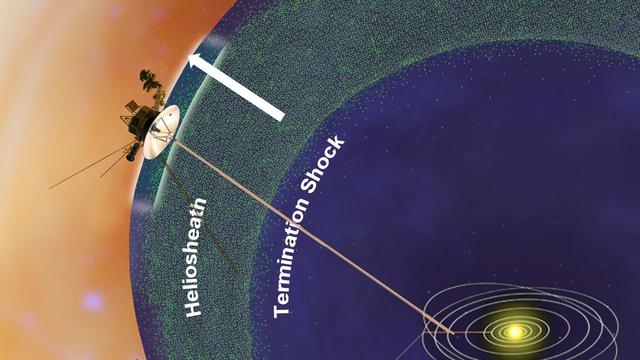
The heliopause is the boundary where the solar wind — a continuous stream of charged particles from the Sun — finally loses its battle against the interstellar medium. Crossing it marks entry into true interstellar space.
In August 2012, after 35 years of flight, Voyager 1 crossed this threshold. NASA confirmed the achievement in September 2013 after its plasma wave instrument detected a sudden jump in plasma density consistent with the interstellar medium. Voyager 2 followed on November 5, 2018, giving scientists two simultaneous data points on the heliosphere's boundary structure for the first time.
As of September 2026:
- Voyager 1 is approximately 24.5 billion km from the Sun — more than 163 astronomical units (AU), where 1 AU is the Earth–Sun distance
- Voyager 2 is approximately 20.6 billion km away — around 138 AU
- A radio signal from Voyager 1 takes over 22 hours to reach Earth, travelling at the speed of light
"From beyond the solar wind's last reach, these two machines have given us the only in-situ measurements of interstellar space humanity has ever gathered — two data points at the edge of everything we call home."
The Golden Record
Aboard each Voyager is one of the most poetic objects humanity has ever constructed: a 12-inch gold-plated copper phonograph record. Assembled under the direction of astronomer Carl Sagan, the Golden Record was designed as a message in a bottle cast into the cosmic ocean — intended for any intelligent civilisation that might one day intercept the probe.
The record contains greetings in 55 human languages, 116 encoded photographs of Earth and its inhabitants, 90 minutes of music spanning cultures and centuries from Bach to Chuck Berry, and natural sounds of the planet: waves, wind, thunder, birdsong, and a mother's first words to a newborn. A stylus and instructions for playing the record are engraved on its cover.
Power, Silence, and Longevity
The Voyagers are powered by radioisotope thermoelectric generators (RTGs), which convert heat from the radioactive decay of plutonium-238 into electricity. Output has declined by approximately 4 watts per year. NASA has systematically powered down instruments over the decades to preserve the mission, switching off cameras long ago and more recently deactivating individual science instruments on both probes.
Engineers expect to maintain contact with at least one spacecraft into the late 2020s. After that, the Voyagers will continue their silent journey through the galaxy — unreachable, but not forgotten, carrying a golden record toward the stars.