Astrophysics · Compact Objects
What Is a Neutron Star? Extreme Physics at the Edge of Existence
S
Editorial Team
September 19, 2026 · 8 min read
A teaspoon of neutron star material weighs approximately a billion tonnes on Earth. The entire object — more massive than the Sun — is only 20 kilometres across, roughly the size of a city. When a massive star exhausts its fuel and collapses, if the remnant core lands in the right mass range, it does not become a black hole. It becomes something almost as extreme: a neutron star, a tightly packed sphere of nuclear matter where ordinary physics hits its limits.
These are not hypothetical objects. Thousands of neutron stars have been catalogued. We detect them as pulsars, magnetars, and the sources of gravitational waves. They are, in many ways, the most extreme laboratories in the observable universe — places where the laws of physics operate at limits we cannot reproduce in any terrestrial experiment.
How a Neutron Star Forms
Stars spend their lives in a balance between gravity, which pulls inward, and radiation pressure from nuclear fusion, which pushes outward. When a massive star has burned through its hydrogen, helium, carbon, and heavier elements all the way to iron — the end of the fusion chain, because iron fusion absorbs energy rather than releasing it — there is nothing left to hold the core up.
Collapse happens on a timescale of milliseconds. The core free-falls inward. As density climbs, electrons are forced to combine with protons: p⁺ + e⁻ → n + νe. Protons become neutrons, releasing a flood of neutrinos. The outer layers, still falling, hit the stiffening core and bounce — the shockwave we observe as a core-collapse supernova, one of the brightest events in the universe.
What's left behind is the neutron star: a tightly packed sphere of neutrons held up not by fusion but by neutron degeneracy pressure — a quantum mechanical effect arising from the Pauli exclusion principle, which forbids two neutrons from occupying the same quantum state. If the remnant core exceeds roughly 2–3 solar masses, even this pressure fails and a black hole forms instead.
The Numbers Don't Make Intuitive Sense
The density of a neutron star is roughly 4 × 10¹⁷ kilograms per cubic metre — comparable to the density of an atomic nucleus. This is not a metaphor. Neutron star matter essentially is nuclear matter, stretched across a 20 km sphere. The boundary where normal matter transitions to this exotic nuclear state is called the crust, and it is only about a kilometre thick.
"A neutron star packs more mass than the Sun into a sphere the size of a city. If you could stand on its surface — which you cannot, because the surface gravity is about 200 billion times Earth's — you would weigh 200 billion times what you weigh now."
Surface gravity runs to roughly 2 × 10¹¹ m/s² — two hundred billion times Earth's. A one-metre fall on a neutron star's surface would accelerate you to about 2,000 km/s before impact. The escape velocity is roughly half the speed of light. General relativity, not Newtonian gravity, is needed to correctly describe motion near a neutron star.
The surface temperature of a young neutron star reaches 10 million Kelvin or more, making them soft X-ray sources detectable by observatories like Chandra and XMM-Newton. They cool over millions of years by emitting neutrinos from the interior and photons from the surface.
Enjoying this? Get one article like this every week — free. Subscribe below →
Magnetic Fields and Rotation
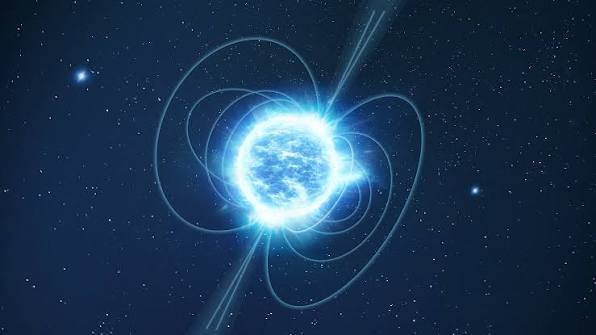
The progenitor star had a magnetic field. When its core collapses by a factor of roughly 100,000 in radius, magnetic flux is conserved — which means field strength increases by the square of the radius ratio. Neutron stars therefore inherit intensely amplified magnetic fields, typically ranging from 10⁸ to 10¹⁵ Gauss (for comparison, Earth's field is about 0.5 Gauss).
Rotation speeds up too, by the same conservation of angular momentum that makes a spinning ice skater speed up when pulling in their arms. Newly formed neutron stars may spin tens or hundreds of times per second. Combined with the strong magnetic field, this creates a rotating magnetic dipole that accelerates charged particles to near-light speeds, producing beams of radiation that sweep through space like a lighthouse — what we detect on Earth as a pulsar.
Types of Neutron Stars
- Radio pulsars — the classic category: rotating neutron stars emitting a beam of radio waves detectable each time it sweeps past Earth. Roughly 3,000 known.
- Millisecond pulsars (MSPs) — neutron stars spun up to hundreds of rotations per second by accreting matter from a binary companion. The fastest known, PSR J1748−2446ad, spins 716 times per second. MSPs are extraordinarily stable timekeepers — more precise than many atomic clocks.
- Magnetars — neutron stars with fields exceeding 10¹³ Gauss, the strongest known magnetic fields in the universe. Magnetars occasionally produce massive X-ray and gamma-ray flares. SGR 1806−20 produced a December 2004 flare energetic enough to temporarily ionise Earth's ionosphere from 50,000 light-years away.
- X-ray binaries — neutron stars accreting from a companion star, bright in X-rays. Systems like Cygnus X-2 and Her X-1 have taught us much about accretion physics and neutron star structure.
What's Inside? An Open Question
The interior of a neutron star remains one of the outstanding unsolved problems in physics. We know the crust contains a lattice of neutron-rich nuclei and free neutrons. Deeper in, neutrons may flow as a superfluid. At the very centre — where densities may exceed nuclear density by a factor of several — the state of matter is unknown.
Candidates for core matter include:
- Hyperons — baryons containing strange quarks, which would soften the equation of state and allow more massive neutron stars to collapse more easily
- Quark matter — free quarks and gluons, if nuclear confinement breaks down at extreme densities
- Strange quark matter — a hypothetical stable state of roughly equal numbers of up, down, and strange quarks
Gravitational wave detections of neutron star mergers — particularly the tidal deformability measured during the inspiral of GW170817 — constrain the equation of state and set limits on neutron star radii. Current data favour a radius of roughly 11–13 km for a canonical 1.4 solar mass neutron star, which rules out some extreme soft equations of state but leaves open significant uncertainty about the deep interior.
The most massive neutron star measured to date is PSR J0740+6620 at approximately 2.08 solar masses. Since any object exceeding the maximum neutron star mass should collapse into a black hole, the maximum mass is a direct probe of the high-density equation of state — and it continues to challenge our models.
What's Inside a Neutron Star?
The interior of a neutron star is one of the most inaccessible environments in the universe. We cannot observe it directly, and no terrestrial experiment can reproduce its conditions. What we know comes from combining nuclear physics theory with astrophysical observations — an enterprise called nuclear astrophysics.
The crust
The outer kilometre or so of a neutron star is a solid crystalline lattice of neutron-rich nuclei embedded in a sea of free electrons. Near the inner crust, neutrons also drip free from nuclei and flow between them. This is the only region analogous to ordinary matter — exotic, but connected to known nuclear physics. The solid crust is responsible for pulsar glitches: sudden spin-ups thought to arise when the crust cracks or when superfluid neutrons in the inner crust transfer angular momentum to the rigid lattice.
The outer core
Below the crust, matter transitions to a uniform fluid of free neutrons, protons, electrons, and muons. The neutrons here are almost certainly in a superfluid state — a quantum mechanical phase where pairs of neutrons condense and flow without resistance. The protons are likely superconducting. The evidence for these exotic states comes partly from observations of neutron star cooling: the Cassiopeia A neutron star (at the centre of a ~340-year-old supernova remnant) was observed to cool faster than standard models predicted, consistent with a transition to core superfluidity occurring in real time.
The inner core — the unknown
At densities above roughly twice nuclear saturation density (~2.8 × 10¹⁷ kg/m³), the equation of state is genuinely unknown. The possibilities include:
- Hyperons: Strange quarks bound into hyperons (such as Λ, Σ, Ξ particles) become energetically favoured at high density. However, most hyperon-including equations of state produce maximum masses below 2 solar masses — in tension with observed massive neutron stars. This is the "hyperon puzzle."
- Quark matter: At extremely high densities, the hadronic structure may dissolve and quarks roam freely in a quark-gluon plasma. Some models propose a "quark core" — a mixed phase or a sharp transition from hadronic to quark matter deep inside the most massive neutron stars. Whether this occurs, and whether the quark matter is in a colour superconducting phase, remains unsettled.
- Kaon condensates and pion condensates: Other exotic phases predicted by various nuclear models, none confirmed.
The NICER (Neutron Star Interior Composition Explorer) mission, mounted on the International Space Station, measures the X-ray light curves of pulsars to constrain their radii with high precision. Combined with mass measurements from pulsar timing and radius/tidal deformability constraints from gravitational waves (GW170817 constrained the neutron star radius to roughly 11–13 km), the picture is gradually narrowing. The interior remains one of the last genuinely unknown phases of matter in the universe.
Neutron Stars as X-ray Binaries and Fast Radio Burst Sources
Many neutron stars are not isolated. When a neutron star is in a binary system with a companion that overflows its Roche lobe — the critical gravitational surface — matter streams onto the neutron star's surface or into an accretion disc around it. The gravitational energy released is enormous: accreting a cubic centimetre of hydrogen onto a neutron star releases energy equivalent to a nuclear bomb per gram, simply from the gravitational potential.
X-ray binaries
Accreting neutron stars are among the brightest X-ray sources in the sky. As matter spirals inward through the accretion disc, it heats to tens of millions of kelvin and radiates in X-rays. When enough hydrogen accumulates on the surface, it can undergo thermonuclear runaway — a Type I X-ray burst — lasting seconds to minutes and temporarily outshining the accretion luminosity. Thousands of X-ray bursts have been observed and used to infer neutron star radii and compositions.
Some X-ray binaries contain neutron stars being spun up by accretion — the "recycling" process that creates millisecond pulsars. Before becoming millisecond pulsars, these objects pass through a "redback" or "black widow" phase in which the neutron star's pulsar wind is ablating the companion, eventually turning it into a semi-degenerate or entirely evaporated remnant.
Fast radio bursts and magnetars
Fast radio bursts (FRBs) are millisecond-duration pulses of radio waves arriving from cosmological distances — billions of light-years away — with an energy release comparable to the Sun's entire annual output, concentrated in a millisecond. Their origin was debated intensely after the first discovery in 2007. In 2020, the Galactic magnetar SGR 1935+2154 produced an FRB-like event detectable within our own galaxy, providing the first direct evidence that at least some FRBs originate from magnetars. Whether all FRBs are magnetar-origin, or whether other source classes contribute, remains an active research question. Upcoming radio arrays — including CHIME/FRB in Canada and DSA-2000 planned for the Nevada desert — are detecting FRBs at rates of thousands per day and building a population large enough for statistical constraints on their origin.