
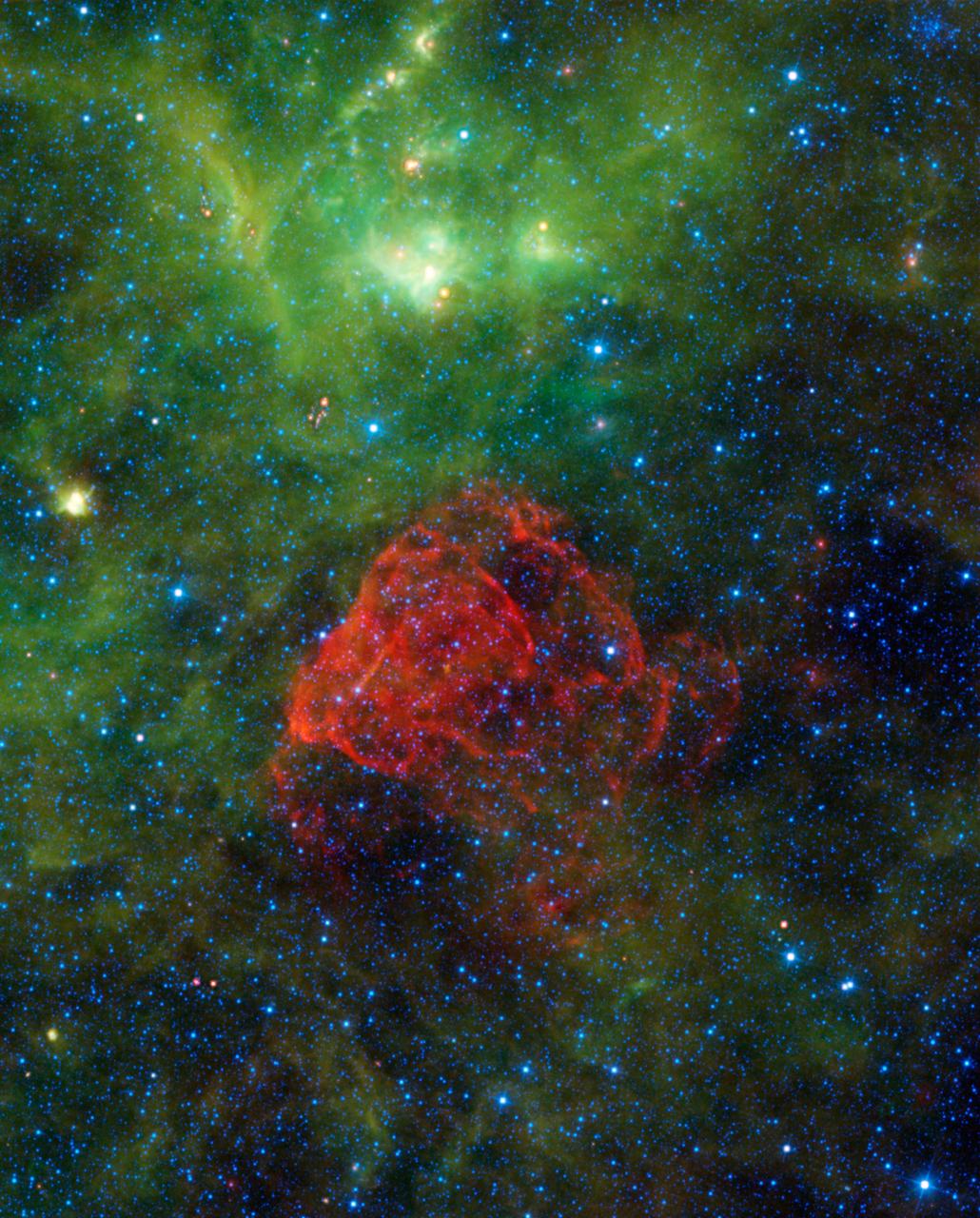
In February 1987, neutrino detectors buried beneath the Japanese Alps and the shores of Lake Erie simultaneously registered a burst of particles that had travelled 168,000 light-years from a star in the Large Magellanic Cloud. Within hours, astronomers using ground-based telescopes watched a point of light bloom in the southern sky into Supernova 1987A — the closest supernova observed since Johannes Kepler spotted one in 1604. That single event, watched in real time across wavelengths from radio to gamma rays, taught physicists more about the death of massive stars than decades of theory had managed. A supernova is not merely a large explosion. It is one of the universe's most consequential processes: a stellar death that creates, destroys, and reshapes everything in its neighbourhood.
Types of Supernovae
Astronomers classify supernovae primarily by their spectra and light curves — the pattern of brightness over time — and the two main classes reflect fundamentally different physical mechanisms.
Core-collapse supernovae, designated Type II and related subtypes (Ib, Ic), occur when a massive star — generally one with at least 8 solar masses — exhausts its nuclear fuel and its iron core collapses under gravity. The collapse proceeds at roughly a quarter of the speed of light, compressing the core from roughly the size of Earth to a sphere only 20 kilometres across in less than a second. The resulting bounce and shockwave, amplified by a flood of neutrinos streaming outward from the collapsing core, tears the outer layers of the star apart. SN 1987A was a core-collapse supernova, and the 24 neutrinos detected across the world that February night — out of the 1058 produced — were enough to confirm the basic picture theorists had sketched for decades.
Type Ia: The Standard Candle
Type Ia supernovae arise by a completely different mechanism and have had an outsized impact on cosmology. They occur in binary star systems where a white dwarf — the remnant of a low-mass star — accretes material from a companion. When the white dwarf's mass approaches approximately 1.4 solar masses (the Chandrasekhar limit), electron degeneracy pressure can no longer support it. Carbon fusion ignites in a runaway thermonuclear explosion that obliterates the entire white dwarf in seconds, leaving no remnant at all.
Because Type Ia supernovae always detonate at nearly the same mass — and therefore release nearly the same total energy, reaching a peak luminosity of roughly 5 billion times that of the Sun — they serve as remarkably consistent distance indicators. Astronomers measure their apparent brightness and compare it to their known intrinsic brightness to derive distances across billions of light-years with precision impossible by any other means. It was this technique that revealed, in 1998, that the universe's expansion is accelerating — a discovery that pointed to the existence of dark energy and earned the Nobel Prize in Physics in 2011.
What Happens in a Supernova
The physical violence of a core-collapse supernova is almost impossible to overstate. In the first 10 seconds, the collapsing core releases approximately 3 × 1046 joules of energy — roughly 100 times the total energy the Sun will radiate over its entire 10-billion-year lifetime. About 99% of that energy is carried away by neutrinos, which stream through the star's outer layers so freely that most of them escape without a single interaction. The remaining 1%, transferred to the stellar envelope by the shockwave and neutrino heating, is still enough to drive an explosion that ejects several solar masses of material at speeds of 10,000 to 30,000 kilometres per second — up to 10% of the speed of light.
In the time it takes to read this sentence, a core-collapse supernova releases more energy than the Sun has emitted since it formed 4.6 billion years ago.
The shockwave expands outward, compressing and heating the surrounding interstellar medium. Months after the initial explosion, the ejected material — now called a supernova remnant — continues to expand. The Crab Nebula, the remnant of a supernova observed by Chinese and Arab astronomers in 1054 CE, today stretches approximately 11 light-years across and is still expanding at roughly 1,500 kilometres per second. At its heart pulses the Crab Pulsar, a neutron star rotating 30 times per second, the compressed core left behind by the explosion.
Enjoying this? Get one article like this every week — free. Subscribe below →
The Legacy of Supernovae
The most enduring contribution of supernovae is chemical. The Big Bang produced only hydrogen, helium, and trace amounts of lithium. Every heavier element — the carbon, nitrogen, oxygen, phosphorus, and calcium that biology requires; the iron, nickel, and cobalt that build planetary cores; the gold, platinum, and uranium whose origins puzzled physicists for generations — was manufactured inside stars and scattered by stellar explosions.
Supernovae are particularly responsible for elements heavier than iron, which cannot be produced by standard stellar nucleosynthesis. Two processes are at work. The rapid neutron-capture process (r-process) occurs in the extreme neutron-rich environment during a core collapse or in the merger of two neutron stars — an event detected for the first time as both gravitational waves (GW170817) and electromagnetic radiation in August 2017. The r-process can build nuclei all the way up to uranium and beyond in a fraction of a second. The elements dispersed by these events are staggering:
- Oxygen is the third most abundant element in the universe — almost all of it was produced by massive stars and dispersed by core-collapse supernovae.
- Iron is forged in the final silicon-burning stage of massive stars; a single supernova can eject 0.1 to 0.5 solar masses of it.
- Gold and platinum are now believed to originate primarily in neutron-star mergers, though some may come from rare, rapidly rotating core-collapse supernovae.
- Calcium — the element in your bones — is produced in both thermonuclear and core-collapse events; a specialised subclass called calcium-rich transients may produce a disproportionate fraction of the universe's calcium supply.
- Radioactive nickel-56, produced in abundance during a Type Ia explosion, decays to cobalt-56 and then to stable iron-56, and its radioactive glow powers the light curve of the supernova for weeks after the initial peak.
Supernovae also trigger the next generation of star formation. The shockwave from an explosion compresses nearby molecular clouds, initiating the collapse that produces new protostars. There is serious evidence that the formation of our own Solar System, 4.6 billion years ago, was triggered by a nearby supernova whose radioactive isotopes — aluminium-26 in particular — are preserved as anomalies in primitive meteorites. In the most literal sense, a supernova may be responsible for the fact that you exist at all.