
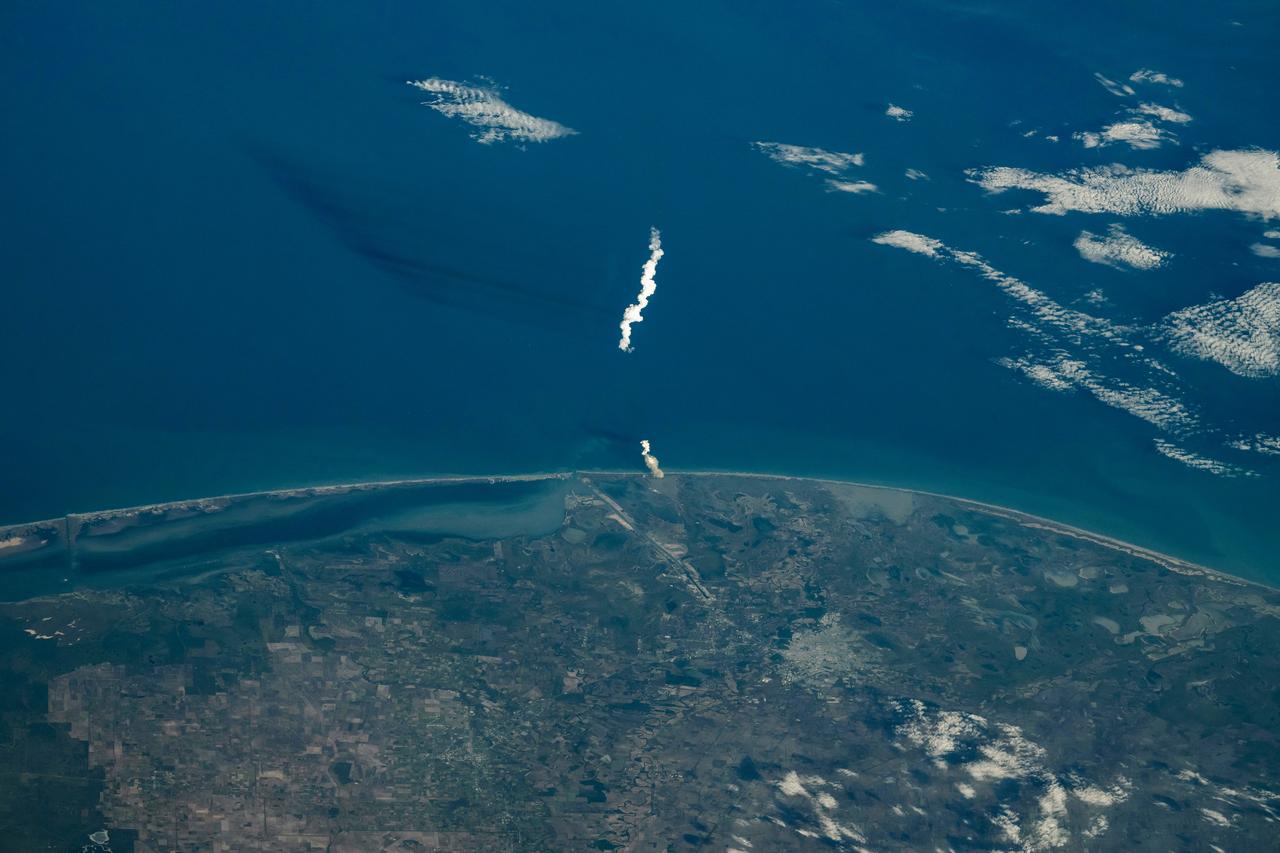
Nothing in the history of rocketry has been attempted quite like Starship. At 121 metres tall — taller than the Statue of Liberty with its pedestal — and nearly 9 metres in diameter, SpaceX's fully reusable launch system is the largest rocket ever built. Its Super Heavy booster generates approximately 74 meganewtons of thrust at liftoff, powered by 33 Raptor engines burning methane and liquid oxygen. That is more than twice the thrust of the Saturn V, which carried Apollo astronauts to the Moon on five F-1 engines producing roughly 34 meganewtons.
But sheer scale is only part of the story. What makes Starship genuinely transformative is the engineering philosophy behind it: every component that leaves the launch pad is designed to land itself and fly again, ideally within hours. If SpaceX achieves that goal at high flight rates, the cost of placing a kilogram in orbit — currently measured in thousands of dollars — could fall by one or two orders of magnitude, opening space to applications that are presently unaffordable.
Fully Reusable, Fully Giant
Starship is a two-stage vehicle. The lower stage, the Super Heavy booster, is 71 metres tall and carries the 33 Raptor 2 engines that provide all the thrust for the first phase of ascent. After separating from the upper stage — also called Starship, in a naming convention that initially confuses almost everyone — the booster performs a boostback burn, then a landing burn, to return to the launch site. At SpaceX's Starbase facility near Boca Chica in south Texas, a 146-metre steel tower nicknamed "Mechazilla" by the company's engineers catches the returning booster in a pair of large mechanical arms before it touches the ground.
The upper stage, the Ship, is 50 metres tall and is powered by six Raptor engines: three optimised for sea-level operation and three vacuum-optimised variants with expanded nozzles for maximum efficiency in space. On reentry, the Ship orients itself belly-first and uses body flaps — large control surfaces at the nose and aft — to fly through the atmosphere like a skydiver, bleeding kinetic energy across a long reentry arc. Near the ground it flips to vertical and performs a propulsive landing, or is similarly caught by the launch tower's arms.
The vehicle is designed to carry up to 150 metric tonnes of payload to low-Earth orbit in its fully reusable configuration — more than three times the capacity of any currently operating rocket. Payload capacity to LEO climbs further in an expendable upper-stage configuration that dispenses with the propellant needed for return.
The Integrated Flight Tests
SpaceX has conducted its orbital-class flight testing from Starbase, and each test flight has pushed substantially beyond the previous one. The programme progressed rapidly through a series of Integrated Flight Tests (IFTs) beginning in 2023.
When a booster the size of a twelve-storey building floats back down and slots into mechanical arms on the launch tower, the economics of reaching space change — not eventually, but immediately.
Catching the Booster
The programme's most striking milestone came on October 13, 2024, during IFT-5. For the first time in history, a rocket booster returning from a high-altitude flight was caught mid-air by the mechanical arms of the launch tower. The Super Heavy booster, having separated from the Ship at an altitude of roughly 70 kilometres and performed a series of controlled burns, descended to a near-hover above the tower and was captured by the arms — a feat that had been described as science fiction by critics of the programme only months before. The Ship completed most of its planned trajectory and executed a controlled splashdown in the Indian Ocean.
IFT-6, flown in November 2024, repeated the booster catch and further demonstrated controlled Ship reentry. Each flight validated hardware that had literally just come off the production line at SpaceX's Starbase manufacturing facility, reflecting the company's philosophy of building and testing rapidly rather than designing exhaustively on paper.
Enjoying this? Get one article like this every week — free. Subscribe below →
- IFT-1 (April 2023): first full-stack flight from Starbase; vehicle lost after stage separation failure at T+4 minutes
- IFT-2 (November 2023): first successful hot-stage separation; Ship reached space before loss of vehicle on reentry
- IFT-3 (March 2024): Ship completed nearly its full planned trajectory; both stages lost during descent and reentry phases
- IFT-4 (June 2024): both stages splashed down in controlled ocean landings, demonstrating successful reentry for both
- IFT-5 (October 2024): Super Heavy booster caught by tower arms for the first time; Ship splashdown in Indian Ocean
- IFT-6 (November 2024): second successful booster catch; Ship successfully caught by tower arms as well
What Starship Is For
NASA selected a modified Starship as the Human Landing System (HLS) for the Artemis programme under a contract awarded in April 2021. The Starship HLS — a variant without aerodynamic control surfaces, optimised for lunar operations — will take astronauts from lunar orbit to the surface and back for the first time since Apollo 17 in December 1972. The Artemis III mission targets the lunar south pole, a region of permanent shadow where water ice has been confirmed by orbital instruments.
Starship HLS requires a critical capability that SpaceX is developing in parallel: orbital propellant transfer. To reach the Moon with a full fuel load, a Starship acting as propellant depot must first launch to low-Earth orbit, receive multiple tanker flights to fill its tanks, and then wait for the crew Starship to rendezvous and transfer fuel. This depot-and-transfer architecture is novel enough that NASA has funded a separate Starship tanker demonstration mission as a precondition for the crewed lunar landing.
Beyond the Moon, SpaceX's declared purpose for Starship is Mars. The propellant choice — methane and liquid oxygen — is partly driven by the fact that both can theoretically be synthesised from Martian water ice and atmospheric carbon dioxide via the Sabatier process and electrolysis, enabling in-situ propellant production that would make the return trip feasible. SpaceX has stated its intent to send uncrewed Starships to Mars in the late 2020s, with crewed missions following once the propellant production infrastructure is established.
Closer to home, Starship is already reshaping the satellite launch industry. SpaceX's next-generation Starlink V3 satellites are designed for the vehicle's payload bay and are too large to fly on any currently operating rocket. Whether Starship ultimately fulfils its grander ambitions or not, its early test flights have already demonstrated capabilities — a booster that catches itself on a tower, a ship that survives reentry on its second attempt — that would have seemed implausible to almost any outside observer at the programme's start.