
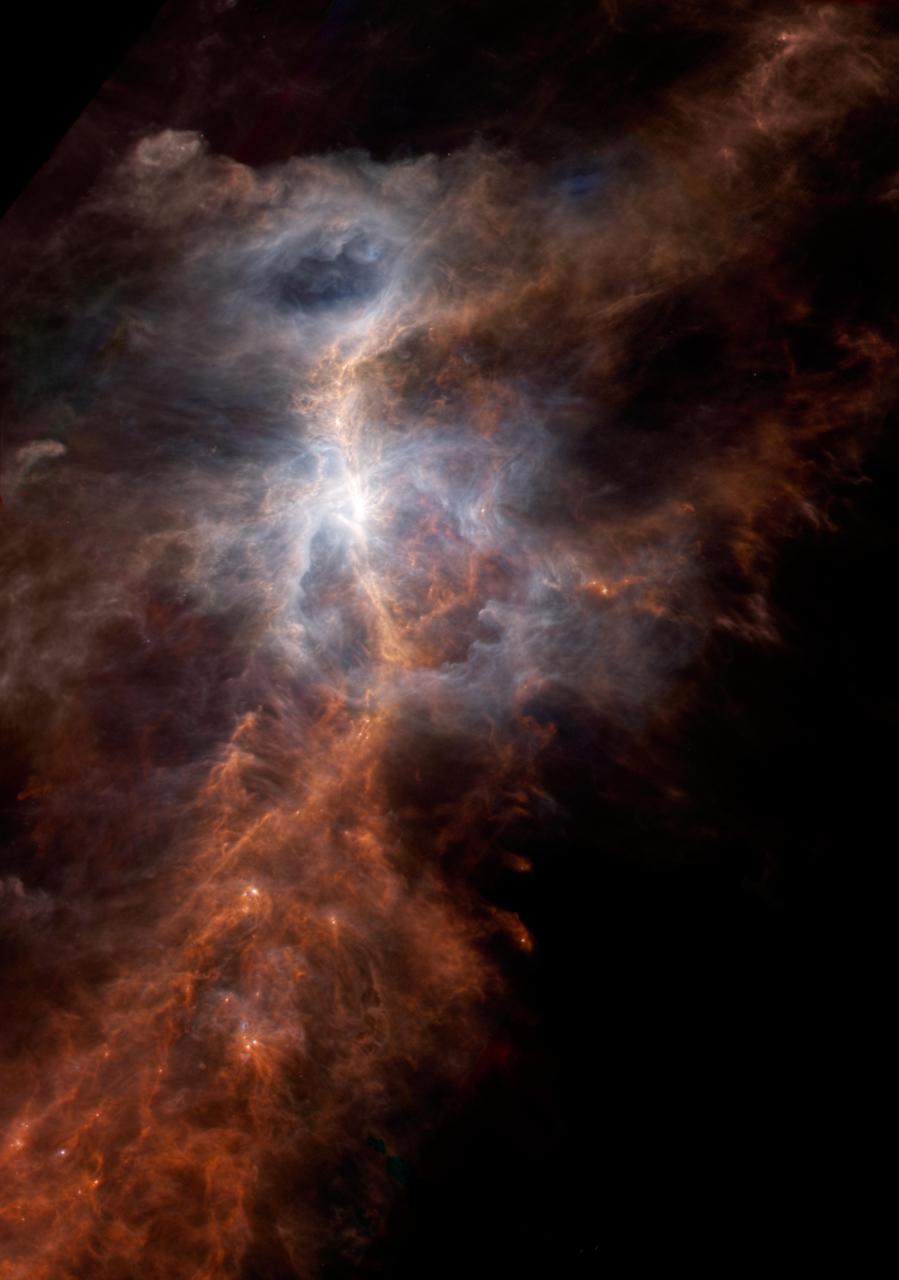
Every atom of carbon in your body was forged inside a star. The iron in your blood was scattered across space by an explosion that outshone entire galaxies. The story of how stars are born, live, and die is not merely one of the great narratives of astronomy — it is the story of how the raw material of life came to exist at all. Stellar evolution, the study of how stars change over time, has revealed a universe engaged in a continuous act of chemical creation, building complexity from the simplest elements hydrogen and helium left over from the Big Bang.
Birth in the Nebula
Stars begin their lives inside giant molecular clouds — vast regions of gas and dust that span tens to hundreds of light-years and contain enough material to form thousands of stars. These clouds are cold, hovering at temperatures as low as 10 Kelvin (about −263°C), and they are kept from collapsing by a balance of thermal pressure and magnetic fields. Collapse begins when something disturbs this balance: a shockwave from a nearby supernova, the gravitational nudge of a passing spiral arm, or the simple accumulation of enough mass in one region.
As a region collapses, it fragments into smaller clumps. Each clump heats up as gravitational energy is converted into heat — a process described by the virial theorem. Over thousands of years, the central region becomes a protostar: an opaque ball of gas still gathering mass from a surrounding disc of material. In many cases, this disc is the birthplace of a planetary system, as dust grains stick together, grow, and eventually sweep their orbits clear. The James Webb Space Telescope has imaged such protoplanetary discs in extraordinary detail inside the Orion Nebula, revealing structures only 200 to 300 AU across that represent solar systems in their earliest formation stages.
Eventually, the protostar's core reaches temperatures of around 10 million Kelvin, and nuclear fusion ignites. Hydrogen nuclei begin fusing into helium, releasing energy through the proton-proton chain reaction. The outward pressure of this radiation exactly balances the inward pull of gravity, and a star is born — in the formal sense, it has arrived on what astronomers call the zero-age main sequence.
Main Sequence: A Star's Long Life
The main sequence is not a place in space but a phase in time — the long, stable period during which a star burns hydrogen in its core. It is the longest phase of any star's life, and the Sun is currently about halfway through its own 10-billion-year main-sequence tenure.
The mass of a star at birth determines everything: its luminosity, its surface temperature, its colour, and above all, its lifespan. The relationship is counterintuitive — more massive stars burn far hotter and faster, exhausting their fuel in a tiny fraction of the time a low-mass star takes. The Hertzsprung-Russell diagram, one of astronomy's most powerful tools, organises stars by luminosity and surface temperature, and nearly all stars fall along a diagonal band — the main sequence — that reflects this mass-luminosity relationship.
A star is not a fixed thing but a negotiation — a constant balance between gravity trying to crush it and the energy of nuclear fire trying to blow it apart.
How Long Does a Star Live?
Stellar lifetimes vary enormously with mass. The key principle is that although massive stars have more fuel, they burn it at such a ferocious rate that they live for a tiny fraction of the time low-mass stars do. Here is how the numbers scale:
- Stars with 60 solar masses (O-type blue giants): main-sequence lifetime of roughly 3 million years — they are born and die before even a single galactic orbit is complete.
- Stars with 10 solar masses (B-type stars): around 20–30 million years on the main sequence.
- Stars with 1 solar mass (like the Sun, a G-type yellow dwarf): approximately 10 billion years.
- Stars with 0.5 solar masses (K-type orange dwarfs): 50 to 100 billion years — longer than the current age of the universe.
- Stars with 0.1 solar masses (M-type red dwarfs): trillions of years, burning so slowly and completely that no red dwarf has ever died of old age since the universe began.
Enjoying this? Get one article like this every week — free. Subscribe below →
Death and Transformation
When a star exhausts the hydrogen in its core, fusion slows and the delicate balance that sustained the main sequence breaks down. What happens next depends almost entirely on mass, making stellar death one of the most dramatic examples of how a single variable — initial mass — can produce radically different outcomes.
Low-mass stars like the Sun follow a relatively gentle path. As the core contracts and heats up, hydrogen begins burning in a shell around the inert helium core. This dumps extra energy into the outer layers, causing them to expand dramatically. The star becomes a red giant, swelling to perhaps 100 times its original diameter. In the Sun's case, this will happen in approximately 5 billion years, at which point it will engulf Mercury, Venus, and possibly Earth. Eventually, helium ignites in a runaway process called the helium flash, and the star begins fusing helium into carbon and oxygen. When helium is exhausted, the outer layers drift away as a beautiful expanding cloud of ionised gas — a planetary nebula — while the core is left behind as a white dwarf: a hot, dense ember roughly the size of Earth, slowly cooling over billions of years.
Massive stars follow a far more violent trajectory. They proceed through a sequence of fusion stages — helium, then carbon, then neon, oxygen, and finally silicon — each stage shorter and hotter than the last. Silicon burning produces iron, and iron is where fusion stops: it costs energy to fuse iron rather than releasing it. When an iron core accumulates mass above about 1.4 solar masses (the Chandrasekhar limit), electron degeneracy pressure can no longer hold it up. The core collapses in less than a second, reaching densities comparable to an atomic nucleus. The outer layers, still falling inward, rebound off this suddenly rigid core in a shockwave — a core-collapse supernova. In its final moments, a massive star releases more energy than the Sun will emit over its entire 10-billion-year life.
What is left behind — a neutron star or a black hole — depends on how much mass the collapsed core retains. And the elements scattered across space by that explosion will drift through the interstellar medium for millions of years, eventually finding their way into a new molecular cloud, a new protostar, and perhaps a new planet where the cycle of stellar evolution begins again.