
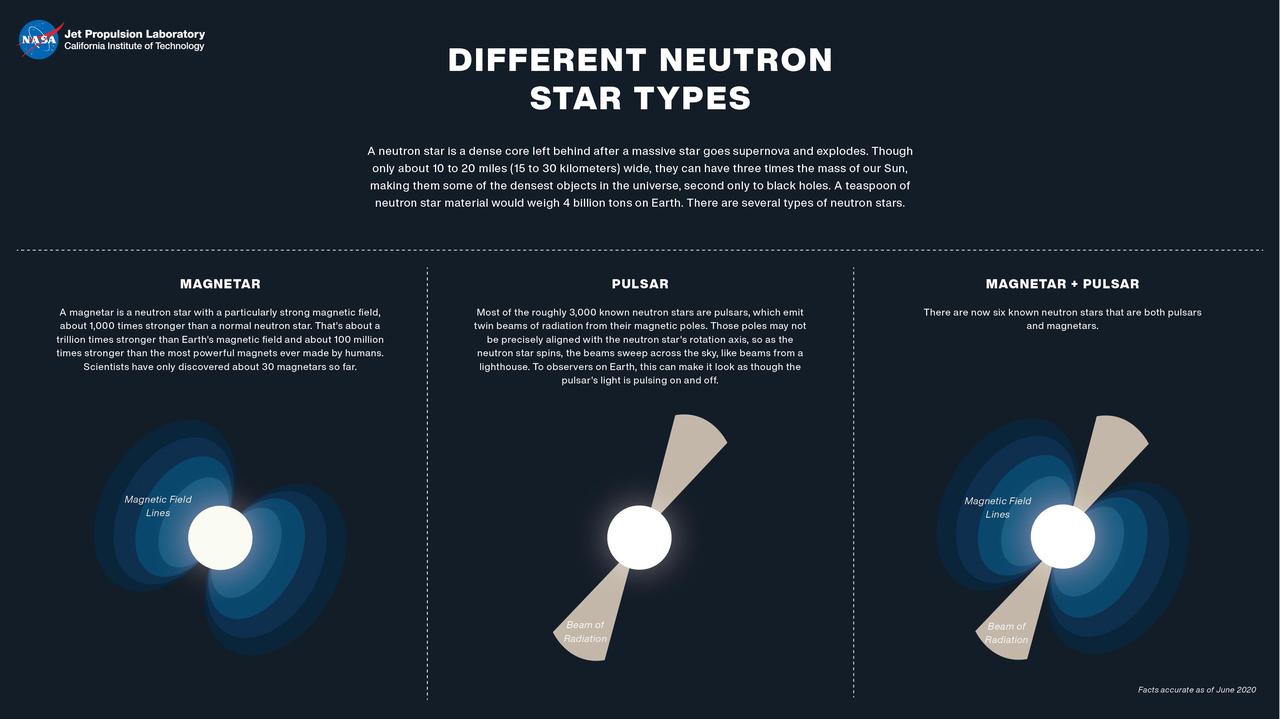
If you could stand one light-year away from a magnetar — a distance of roughly 9.5 trillion kilometres — its magnetic field would still be strong enough to destroy the iron in your red blood cells. You would not, of course, survive the approach: at half the distance from the Earth to the Moon, the magnetar's gravity would pull the atoms of your body apart into a stream of free particles, and its magnetic field would be a million billion times stronger than a hospital MRI scanner. Magnetars are not merely extreme objects. They are objects whose properties strain the language of extremes, hovering at the boundary of what physics can describe and what the human mind can properly imagine.
What Is a Magnetar?
A magnetar is a neutron star — the ultra-dense remnant left behind when a massive star explodes as a core-collapse supernova — with an exceptionally powerful magnetic field. All neutron stars are already remarkable: they pack roughly 1.4 times the mass of the Sun into a sphere only 20 kilometres across, producing densities so extreme that a teaspoon of neutron star material would weigh about 10 million tonnes. Neutron stars also inherit and amplify the magnetic field of their progenitor star during collapse, emerging with surface fields of around 108 tesla — already a billion times stronger than Earth's field of about 0.00005 tesla.
Magnetars take this further by three to four orders of magnitude. Their surface magnetic fields range from 1010 to 1011 tesla — values so extreme that quantum electrodynamics predicts fundamentally strange phenomena. At fields above the so-called Schwinger limit, approximately 4.4 × 10⁹ tesla, the vacuum of space itself becomes polarised: photons travelling through the field split into pairs of virtual particles, X-ray beams bifurcate based on polarisation, and atoms are deformed into elongated needle-like shapes because electrons can no longer occupy spherical orbits. These are not theoretical curiosities — the ESA's INTEGRAL and NASA's NICER missions have both detected signatures consistent with these quantum vacuum effects in magnetar emissions.
The origin of magnetars' extraordinary fields is not fully settled, but the leading model involves a convective dynamo operating in the first second after collapse. If the newly formed neutron star rotates fast enough — with a period of one to two milliseconds — differential rotation and convective overturn in the hot, dense interior can amplify a seed magnetic field by a factor of a trillion or more before the star cools and the dynamo freezes. This is similar in principle to the dynamo that generates Earth's magnetic field, except operating at densities a trillion times higher and on timescales a trillion times shorter.
Outbursts and Giant Flares
Magnetars are not quiet objects. The immense tension stored in their magnetic fields continuously stresses the neutron star's rigid crystalline crust, and when that stress exceeds the crust's breaking point — in what is essentially a stellar earthquake, or starquake — the sudden reconfiguration of the magnetic field releases energy in a burst of X-rays and gamma rays detectable across the galaxy and, in the most extreme cases, across the observable universe.
A magnetar giant flare lasts less time than it takes to blink, yet in that fraction of a second it outshines every star in the Milky Way combined.
The SGR 1806-20 Giant Flare of 2004
The most powerful magnetar event ever recorded struck Earth's upper atmosphere on 27 December 2004. The source was SGR 1806-20, a magnetar located approximately 50,000 light-years away near the centre of the Milky Way. In just 0.2 seconds, it released approximately 2 × 1039 joules of energy — more than the Sun emits in 250,000 years. The initial pulse was so intense that it partially ionised Earth's ionosphere, the same upper-atmospheric layer normally disturbed only by solar flares, despite originating on the far side of the galaxy. Had the magnetar been located at the distance of the Crab Nebula, roughly 6,500 light-years away, the flare would have been comparable to the full Moon in brightness and might have triggered mass extinction events by stripping away ozone. At the distance of the nearest stars, it would have rendered Earth uninhabitable.
Several prominent magnetars and soft gamma-ray repeaters have been catalogued and studied intensively:
- SGR 1806-20: Source of the record-breaking 2004 giant flare; its magnetic field is estimated at around 2 × 10¹¹ tesla, among the strongest measured for any known object.
- 1E 2259+586: Located in the supernova remnant CTB 109, it underwent a major outburst in 2002 in which it released over 80 individual bursts in under four hours and glitched — spun up suddenly — in a way that distorted its rotation period.
- SGR 1935+2154: Made headlines in April 2020 when it produced a burst of radio waves detectable at Earth, making it the first confirmed galactic source of a fast radio burst (FRB) — a class of millisecond-duration cosmic signals whose origins had puzzled astronomers since their discovery in 2007.
- XTE J1810-197: The first magnetar discovered to emit pulsed radio waves; it fell silent in 2008 and then remarkably reactivated in 2018, allowing astronomers to study the turn-on mechanism in real time.
Enjoying this? Get one article like this every week — free. Subscribe below →
Why Magnetars Matter
Beyond their intrinsic strangeness, magnetars have become a critical laboratory for physics that cannot be reproduced anywhere else. The magnetic fields inside a magnetar exceed what any terrestrial experiment will achieve for the foreseeable future by a factor of roughly 10 trillion. They probe quantum electrodynamics — the theory of how light and matter interact — in a regime where its predictions have never been tested by any other means. In 2022, the Imaging X-ray Polarimetry Explorer (IXPE), a NASA mission launched in December 2021, measured the polarisation of X-rays from the magnetar 4U 0142+61 with enough precision to detect the vacuum birefringence effect: the first direct observational confirmation that a strong magnetic field rotates the polarisation of light propagating through it, exactly as quantum electrodynamics predicts.
Magnetars have also reshaped our understanding of fast radio bursts. For years after the discovery of FRBs in 2007, the sources of these millisecond flashes of radio energy — bright enough to be detected across billions of light-years — were entirely unknown. The detection of an FRB-like burst from SGR 1935+2154 in 2020, simultaneously observed by the Canadian Hydrogen Intensity Mapping Experiment (CHIME) and the STARE2 telescope, established beyond reasonable doubt that at least some fast radio bursts originate from magnetars. The mechanism is still debated — leading models invoke synchrotron radiation in a charged plasma above the magnetar's magnetic pole, or shocks driven by material ejected during a burst — but the connection has opened a new window on some of the most distant and energetic radio phenomena in the universe.
Magnetars are also short-lived by cosmic standards. Their magnetic field energy — which powers all their activity — decays on timescales of roughly 10,000 years. As the field weakens, bursting activity stops, the star cools, and eventually the magnetar becomes an ordinary, quiet neutron star indistinguishable from the thousands of radio pulsars the galaxy contains. We can only detect them while they are young and active, which means we are seeing only a small fraction of all the magnetars that have ever existed — a reminder that the universe's most extreme objects spend most of their existence in silence.