The chemical rocket is extraordinarily powerful and extraordinarily wasteful. To hurl a few tonnes of payload into deep space, it must carry hundreds of tonnes of propellant — and burn it all in minutes. The rocket equation, first derived by Konstantin Tsiolkovsky in 1903, imposes hard limits on chemical propellants: exhaust velocities top out at roughly 4.5 kilometres per second no matter how exotic the fuel mixture. Ion propulsion shatters that ceiling. By using electric fields to accelerate charged particles instead of a combustion reaction, ion thrusters can expel propellant at 20 to 90 kilometres per second — more than twenty times faster — achieving efficiencies that fundamentally change what is possible in deep space exploration.
The catch is force. A typical ion thruster produces thrust measurable in millinewtons — less than the weight of a small coin. You would wait a long time for an ion engine to push a car off a parking brake. But spacecraft travelling through the vacuum of interplanetary space require no force to maintain their speed — only to change it. And given weeks, months, or years of continuous, gentle acceleration, the cumulative velocity change, or delta-v, that ion propulsion can deliver far exceeds what any chemical system could achieve with the same propellant mass.
How Ion Propulsion Works
Most operational ion thrusters use a gridded electrostatic architecture. A propellant — almost universally the noble gas xenon, chosen for its high atomic mass, chemical inertness, and relatively low ionisation energy — is fed into a discharge chamber. Electrons are introduced, stripping xenon atoms of an electron and creating positively charged ions. Two parallel grids, charged to opposing potentials of several thousand volts, form a powerful electrostatic lens that accelerates the ions through the apertures at high velocity, expelling them as a beam of exhaust. A separate electron-emitting device called a neutraliser is positioned downstream to prevent the spacecraft from accumulating a negative charge that would attract the exhaust back.
The key performance metric is specific impulse (Isp), a measure of thrust per unit weight of propellant consumed per second — essentially, fuel efficiency for rockets. Chemical rockets achieve Isp values of 300–450 seconds. Gridded ion thrusters routinely achieve 1,500–10,000 seconds. Hall-effect thrusters, a related technology that uses a magnetic field to trap electrons and ionise propellant more efficiently, fall in between at 1,500–3,000 seconds but offer higher thrust density, making them attractive for satellite station-keeping.
Enjoying this? Get one article like this every week — free. Subscribe below →
Missions That Changed Everything
The technology's first operational demonstration came with NASA's Deep Space 1, launched in October 1998. The mission's primary goal was to validate 12 advanced technologies, with the NSTAR ion engine as the centrepiece. The engine operated for over 16,000 hours — shattering endurance records — and propelled the spacecraft past asteroid 9969 Braille and comet Borrelly, returning the closest images of a cometary nucleus at the time. The mission proved that ion propulsion was ready for science.
Ion propulsion doesn't win races — it wins marathons. Given months or years of continuous thrust, it can take spacecraft to places chemical rockets simply cannot afford to reach.
Dawn Mission: Orbiting Two Worlds
No mission has demonstrated ion propulsion's unique capabilities more dramatically than NASA's Dawn spacecraft, launched in September 2007. Dawn carried three NSTAR-derived ion engines and became the first spacecraft in history to orbit two extraterrestrial bodies beyond the Earth-Moon system: the asteroid Vesta, which it orbited from July 2011 to September 2012, and the dwarf planet Ceres, which it entered orbit around in March 2015 and studied until its mission ended in November 2018 when it ran out of hydrazine for attitude control.
The trajectory was only possible with ion propulsion. Dawn had to first decelerate into Vesta's orbit, then escape it and accelerate toward Ceres — a manoeuvre requiring a total delta-v that exceeded what any chemical rocket could provide on a mission of that mass. The spacecraft consumed just 425 kilograms of xenon over its entire 11-year mission.
Japan's Hayabusa missions added another dimension to ion propulsion's portfolio. Hayabusa, launched in 2003, used four microwave discharge ion engines to reach asteroid Itokawa, collect surface samples, and return them to Earth in 2010 — the first asteroid sample return in history. Its successor, Hayabusa2, repeated the feat with asteroid Ryugu in December 2020, delivering capsule samples that have since yielded discoveries about organic compounds and the early solar system.
The Limits and Future of Ion Drives
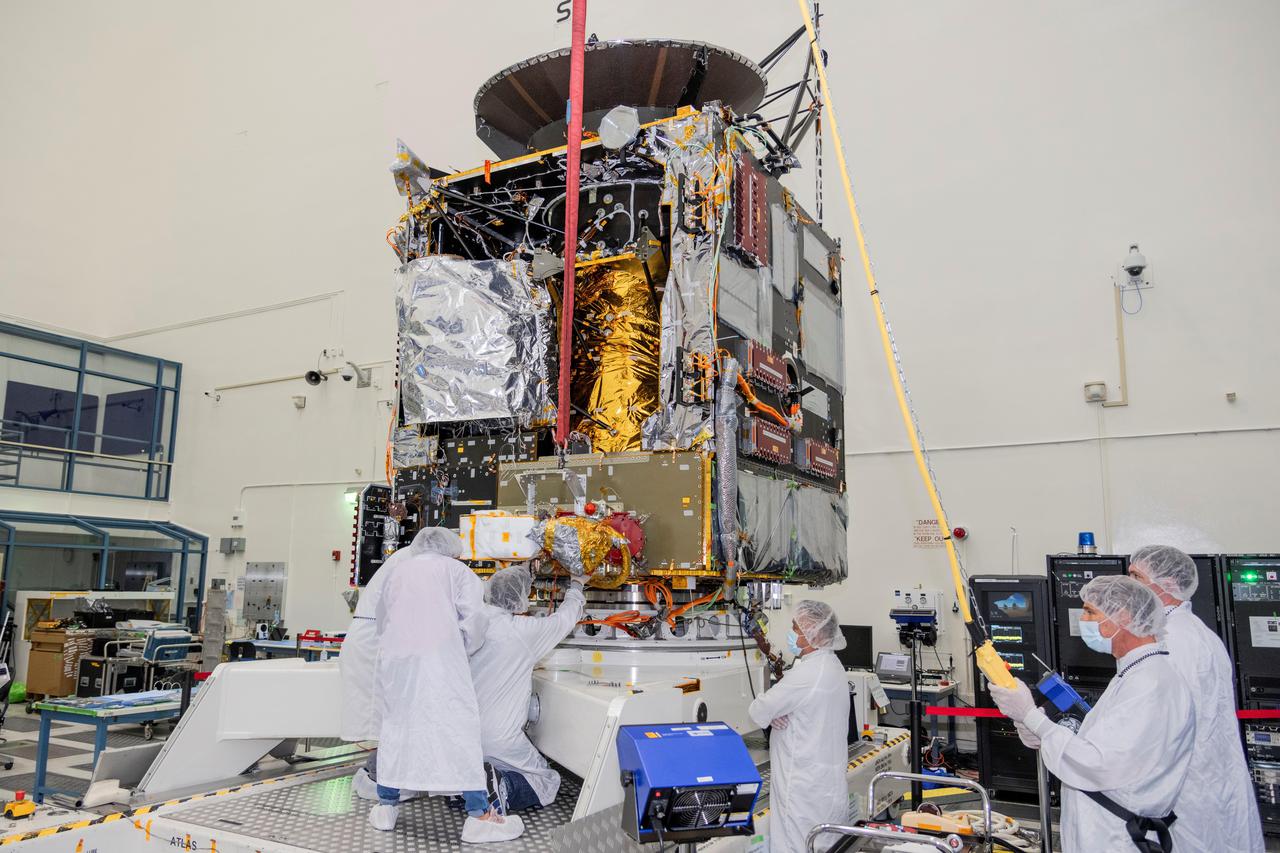
Ion thrusters have real constraints. The most fundamental is power. Accelerating ions to high velocities requires substantial electrical energy — energy that deep space missions must harvest from sunlight. As a spacecraft moves away from the Sun, solar panel output falls with the square of the distance. NASA's Psyche mission, launched in October 2023 toward the metal-rich asteroid 16 Psyche in the main belt, carries a large solar array generating 21 kilowatts at 1 AU specifically to feed its Hall-effect thrusters. At Psyche's distance from the Sun, output drops to roughly 2 kilowatts — still enough for propulsion, but barely.
For missions to Jupiter, Saturn, and beyond, nuclear electric propulsion — pairing a nuclear fission reactor with ion thrusters — is the logical extension. The reactor would provide constant, abundant power regardless of solar distance. NASA and the Department of Energy have conducted preliminary work on nuclear electric propulsion systems capable of hundreds of kilowatts, sufficient to dramatically shorten transit times to the outer planets or even enable crewed missions to Mars.
- Deep Space 1 (1998): first primary ion propulsion mission; flew past asteroid Braille and comet Borrelly
- Dawn (2007–2018): orbited both Vesta and Ceres; only spacecraft to orbit two solar system bodies beyond Earth–Moon
- Hayabusa (2003–2010): first asteroid sample return, using ion engines to reach and depart Itokawa
- Hayabusa2 (2014–2020): returned samples from asteroid Ryugu; ongoing extended mission continues with ion propulsion
- SMART-1 (2003): ESA's first ion-propelled spacecraft, spiralled from Earth orbit to the Moon
- Psyche (2023–ongoing): Hall-effect thrusters powering transit to metal asteroid 16 Psyche
- Starlink v2: SpaceX Hall-effect thrusters provide station-keeping for thousands of broadband satellites
For missions that need to go far, carry modest payloads, and have the luxury of time, ion propulsion has no peer. As the solar system opens up to sustained robotic and eventually human exploration, that niche will only expand.