
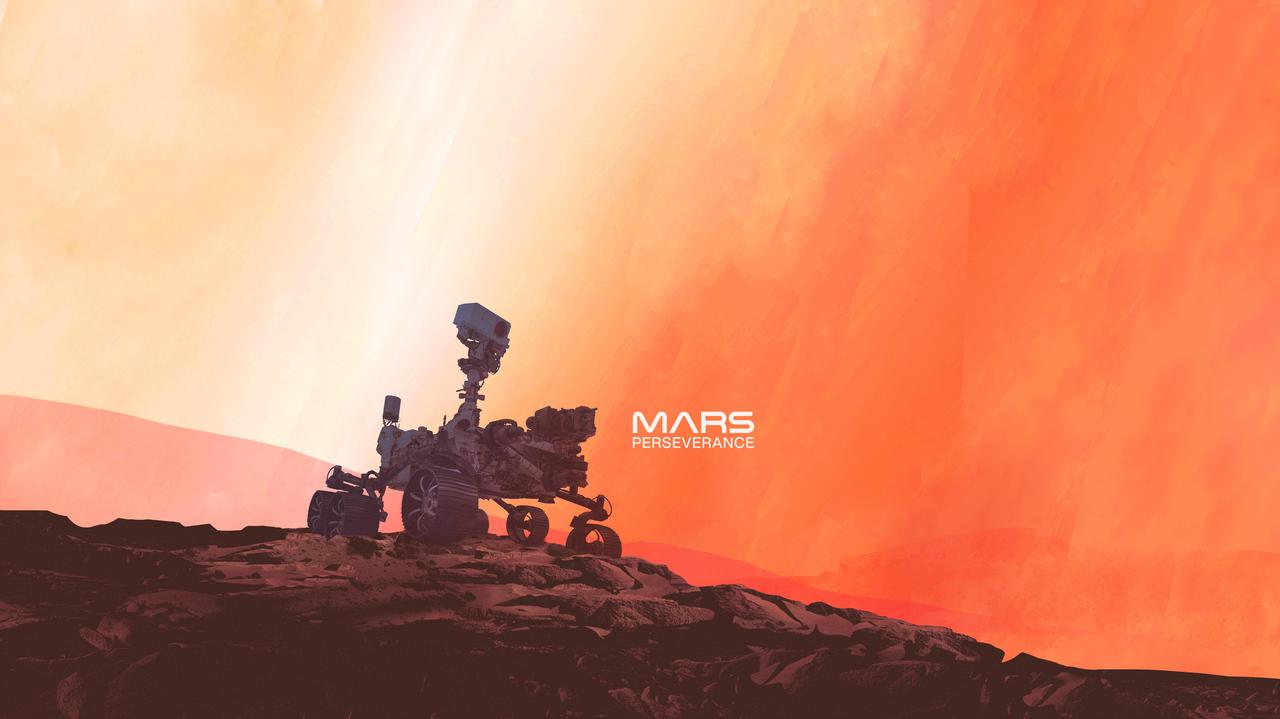
On the night of August 5, 2012, a one-tonne rover descended through the Martian atmosphere at over 20,000 kilometres per hour, slowed by a supersonic parachute, then lowered on nylon cables from a hovering sky crane to the floor of Gale Crater. The sequence — which NASA engineers called "seven minutes of terror" — worked flawlessly. Curiosity had landed. In the years since, it and its successor Perseverance have rewritten the story of the Red Planet.
Curiosity: A Decade of Discovery
The Mars Science Laboratory mission sent Curiosity to Gale Crater because orbital data suggested it had once held a lake. That hypothesis turned out to be correct. Curiosity found mudstone sediments laid down in a stable, long-lived lake environment that persisted for millions of years, providing — in principle — habitable conditions for microbial life. The rover's Sample Analysis at Mars (SAM) instrument detected complex organic molecules preserved in 3.5-billion-year-old rock, confirming that the chemical building blocks of life were present on ancient Mars.
Perhaps the most puzzling discovery came from periodic methane detections. On Earth, roughly 95 percent of atmospheric methane is produced by biological processes. Curiosity detected seasonal spikes in Martian methane that have never been fully explained. The source could be geological — certain rock reactions can generate methane without biology — but the possibility of a biological origin has not been ruled out.
By 2026, Curiosity had driven more than 32 kilometres and climbed over 800 vertical metres up the slopes of Mount Sharp, studying rock layers laid down across different geological epochs like pages of a planetary history book.
Perseverance and the Hunt for Ancient Life
Perseverance landed in Jezero Crater on February 18, 2021. The site was chosen because Jezero is the remnant of an ancient river delta — exactly the kind of environment on Earth where microbial biosignatures are most likely to be preserved. The rover carries instruments specifically designed to search for signs of past life, including SHERLOC, a deep-UV Raman spectrometer capable of detecting organic compounds at the molecular level.
Within its first year, Perseverance found that Jezero Crater's floor was not the lake sediment scientists expected, but volcanic rock — a geologically rich finding that will help constrain the timing of Mars's volcanic history. Above the volcanic basement, the delta deposits did yield fine-grained sedimentary rocks high in organic content, the most promising samples collected by the rover so far.
"Perseverance isn't just looking for life on Mars — it's building the archive that future scientists will study for decades, perhaps centuries, after the samples return to Earth."
Enjoying this? Get one article like this every week — free. Subscribe below →
The Ingenuity Helicopter
Alongside Perseverance rode a 1.8-kilogram helicopter named Ingenuity — a technology demonstration that was expected to attempt five flights. On April 19, 2021, it made history as the first powered, controlled aircraft to fly on another planet, hovering 3 metres above the Martian surface for 39 seconds. It went on to complete more than 70 flights before a rotor blade was damaged in January 2024, ending its operations. Ingenuity proved that aerial exploration of Mars is possible, opening a new dimension for future missions.
What Comes Next: Sample Return
The most consequential science from both rovers may still lie ahead. Perseverance has been drilling and sealing rock cores into titanium tubes, stashing them at carefully selected depots across Jezero Crater. These samples — the first ever collected on Mars for return to Earth — are intended to be retrieved by a future Sample Return mission and analysed in terrestrial laboratories with instruments far more powerful than anything a rover can carry.
- Curiosity landing: August 6, 2012, Gale Crater, using sky crane technology
- Perseverance landing: February 18, 2021, Jezero Crater (ancient river delta)
- Ingenuity first flight: April 19, 2021 — first powered flight on another planet
- MOXIE experiment: Perseverance produced oxygen from Martian CO₂ in 2021, a proof-of-concept for future human missions
- Rock samples collected: Perseverance had filled over 20 sample tubes by early 2026
Embedded in Perseverance's payload is MOXIE — the Mars Oxygen In-Situ Resource Utilization Experiment — which demonstrated for the first time that breathable oxygen can be extracted from the Martian atmosphere's carbon dioxide. A scaled-up version of this technology could produce both the oxygen astronauts need to breathe and the oxidiser rockets need to launch from the Martian surface. The rovers are not just exploring Mars. They are paving the road for the humans who will one day follow.