Within months of opening its eyes, the James Webb Space Telescope found galaxies that shouldn't exist — massive, fully formed structures in the early universe, in a timeframe our best models said was too soon for them to be there. Not a minor discrepancy. Some appeared to contain more stellar mass than entire simulations suggested was possible at that age. Scientists reached for an uncomfortable word: unexpected.
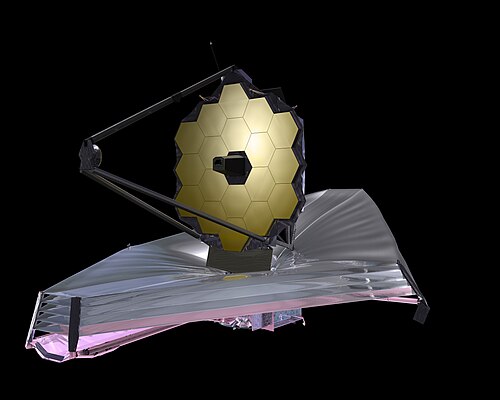
Launched on Christmas Day 2021 and operating since mid-2022, JWST is a joint mission of NASA, the European Space Agency (ESA), and the Canadian Space Agency (CSA). It observes in the near- and mid-infrared — wavelengths that pierce cosmic dust and capture the redshifted light of the earliest galaxies. This article covers three areas where it has already reshaped our understanding: the deep early universe, exoplanet atmospheres, and star formation.
The Early Universe: Galaxies That Shouldn't Exist
One of JWST's primary design goals was to observe the first galaxies, which formed within the first billion years after the Big Bang. Its infrared sensitivity, combined with the 6.5-metre primary mirror, makes it far more capable of detecting these objects than any previous telescope.
"We've found galaxies in the early universe that are larger and more mature than our models predicted. Something about galaxy formation in the first few hundred million years is more efficient than we thought." — paraphrasing the scientific consensus emerging from early JADES and CEERS survey results
The JADES (JWST Advanced Deep Extragalactic Survey) and CEERS (Cosmic Evolution Early Release Science) programs identified galaxies at redshifts above 10 — meaning we are seeing them as they were less than 500 million years after the Big Bang.
The significance of redshift
- Redshift is a measure of how much the universe has expanded since the light left the source. A redshift of z=10 means the universe was about 1/11th its current size — roughly 460 million years after the Big Bang.
- GN-z11, first identified with Hubble and later studied with JWST, has a spectroscopically confirmed redshift of about 10.6 and is among the most distant known confirmed galaxies.
- JWST candidate galaxies at z>12 push to within roughly 350 million years of the Big Bang, earlier than many formation models suggested fully assembled galaxies could exist.
The issue is not that these galaxies violate the Big Bang — it does not. The issue is their mass: some of these early objects contain more stellar mass than current simulations predict should be possible in that short timeframe. Researchers are actively investigating whether this reflects underestimated star formation efficiency, dust accounting adjustments, or something more fundamental. It is genuinely an open research question.
Enjoying this? Get one article like this every week — free. Subscribe below →
Exoplanet Atmospheres: Reading the Chemistry of Other Worlds
JWST is a powerful tool for transmission spectroscopy — when an exoplanet passes in front of its host star, the starlight that filters through the planet's atmosphere is slightly altered. Different molecules absorb different wavelengths. By comparing the spectrum during transit against the spectrum of the star alone, astronomers can identify the atmosphere's chemical composition.
Key discoveries
- WASP-39b and the CO₂ detection: In 2022, JWST delivered the first unambiguous direct detection of carbon dioxide (CO₂) in the atmosphere of an exoplanet — WASP-39b, a "hot Jupiter" about 700 light-years away. JWST's NIRSpec produced a clean, high-resolution spectrum. The full published spectrum also showed water vapour, sodium, potassium, and possible hints of sulphur dioxide from photochemical reactions.
- TRAPPIST-1 system: Early results from TRAPPIST-1b and TRAPPIST-1c suggest these worlds likely lack substantial atmospheres, consistent with intense stellar radiation stripping their gases. The outer, cooler planets remain less characterised and require more observation time.
- K2-18b and the DMS controversy: A 2023 paper reported a tentative detection of dimethyl sulphide (DMS) — on Earth produced almost exclusively by marine life — in the atmosphere of K2-18b. The signal is weak and the attribution uncertain. This is preliminary evidence requiring much more data; no conclusion about biological origin is credible yet.
Star Formation: Seeing Through the Dust
Stars form in dense molecular clouds — regions opaque at visible wavelengths. JWST's infrared vision cuts through dust that would otherwise block our view, revealing what Hubble could not.
Landmark images
- Carina Nebula "Cosmic Cliffs": One of JWST's first released images showed the edge of a star-forming region in the Carina Nebula, ~7,600 light-years away, revealing hundreds of previously hidden protostars and jets of material from newly forming stars.
- Pillars of Creation (revisited): JWST imaged the Eagle Nebula pillars in the near-infrared in 2022, identifying embedded young stars forming within the pillars themselves — invisible to Hubble.
- Protostellar jets (HH 211): In the Herbig-Haro 211 system, ~1,000 light-years away, JWST captured the most detailed image yet of jets from a very young protostar — a stellar embryo only a few tens of thousands of years old.
JWST was designed for a 10-year mission, but a precise launch and fuel-efficient trajectory mean it likely has propellant for 20 or more years of operation. The science shown here represents less than the first three years. The results already published have answered some questions and opened others — precisely what a productive telescope does.
Closer to Home: Solar System Science
Webb's infrared capability is not limited to distant objects. Within our own solar system, it has produced observations impossible from the ground or from Hubble.
Gas giants and their rings
In 2022, Webb imaged Jupiter in the near-infrared, revealing auroral structures at its poles, faint rings, and two small moons — Amalthea and Thebe — against a near-black sky. The images were striking not because Jupiter is unknown, but because Webb captured this level of detail while simultaneously performing science on objects billions of light-years away — a testament to its dynamic range. Neptune's rings, not clearly seen since Voyager 2 flew past in 1989, were resolved by Webb with unusual clarity.
Comets and interplanetary material
Webb observed Comet 238P/Read — one of a class of comets in the outer asteroid belt — and confirmed water vapour in its coma. What it did not detect was carbon dioxide, which is unexpected and raises questions about the comet's formation environment. Subsequent observations of other main-belt comets aim to understand why these water-bearing objects exist so deep inside the solar system.
Titan's atmosphere
Saturn's largest moon, Titan, is the only body in the solar system besides Earth with a dense nitrogen atmosphere and a stable liquid cycle on its surface — not water, but methane and ethane. Webb's observations of Titan detected a bright cloud system in its northern hemisphere, possibly convective, and identified chemical signatures consistent with ongoing photochemistry in the upper atmosphere. The Dragonfly mission, a rotorcraft lander set to arrive at Titan in the 2030s, will eventually sample the surface chemistry Webb is mapping remotely.
The Challenge of Interpreting Webb Data
A recurrent theme in JWST science is the gap between detection and interpretation. The telescope's sensitivity means it can detect signals that would have been invisible to any previous instrument — but extracting physical meaning from those signals requires models that are sometimes not yet ready.
The galaxy formation tension
The early massive galaxies found by JWST have led to genuine scientific debate. Some researchers have argued that the galaxy stellar mass functions — statistical counts of how many galaxies of a given mass exist at a given redshift — exceed what ΛCDM cosmology (the standard model) predicts. Others argue that the discrepancy is within systematic uncertainties: converting observed light into stellar mass requires assumptions about the initial mass function, dust attenuation, and star formation history, each of which introduces error. Resolving this requires spectroscopic confirmation of redshifts (photometric estimates can be wrong) and better calibrated stellar population models at low metallicity.
The DMS detection on K2-18b — why caution is warranted
The 2023 claim of a possible dimethyl sulphide (DMS) detection received enormous media coverage. The scientific community's response was cautious for several reasons: the signal-to-noise ratio is low; DMS can in principle be produced abiotically; K2-18b may not have a liquid water ocean but instead a deep magma ocean beneath a hydrogen-rich atmosphere (the "Hycean" model is not confirmed); and the instrument systematics at those wavelengths are still being characterised. Multiple independent analyses and further observation time are required before any conclusion is credible. This is how science works — preliminary signals are reported, tested, and either confirmed or ruled out over years.
What the next observing cycles will target
- Cycle 3 and beyond: Approved programs include deeper imaging of candidate high-redshift galaxies to confirm or refute their distances, continued atmospheric characterisation of TRAPPIST-1 planets (especially 1e, 1f, and 1g — the potentially habitable-zone worlds), and observations of the galactic centre to probe stellar dynamics around Sgr A*.
- Gravitational lensing fields: Webb uses massive galaxy clusters as natural telescopes — their gravity magnifies background objects up to 100× or more. Programs targeting clusters like Abell 2744 and MACS J0416 are finding galaxies and star clusters at redshifts otherwise inaccessible even to Webb.
- Transient science: Webb has observed supernovae, gamma-ray burst afterglows, and tidal disruption events — cases where a star is torn apart by a supermassive black hole. Its infrared coverage fills a gap that ground-based observatories cannot reach.