Exoplanets · Planetary Science
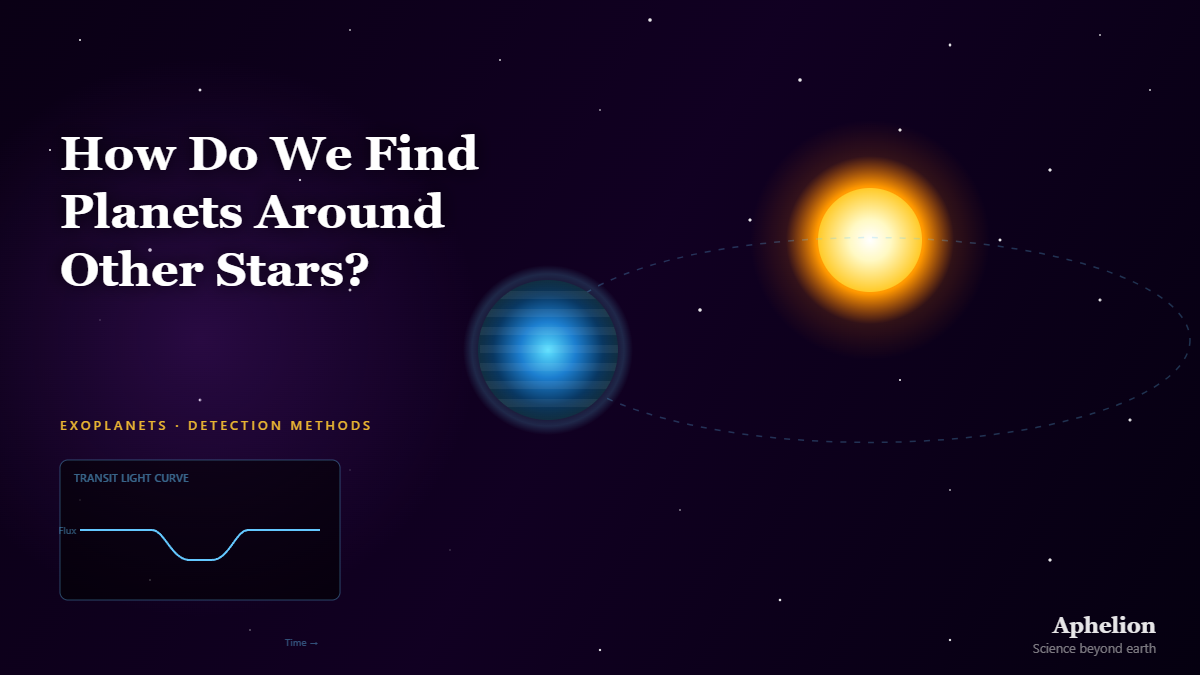
How Do We Find Planets Around Other Stars?
S
Editorial Team
September 19, 2026 · 7 min read
The first confirmed detection of a planet orbiting a Sun-like star came in 1995, when Michel Mayor and Didier Queloz announced the discovery of 51 Pegasi b — a gas giant half the mass of Jupiter orbiting its host star in just 4.2 days. That discovery earned them the 2019 Nobel Prize in Physics. Since then, astronomers have confirmed more than 5,700 exoplanets using a suite of complementary methods.
None of these methods involves seeing a planet the way you see a photograph of Mars. The distances involved are vast, the planets are faint, and they sit next to enormously bright stars. Instead, astronomers detect indirect signals — changes in starlight, shifts in stellar motion, gravitational lensing events — and infer the planet's existence from those signals.
"We have found a solar system's worth of planets for every star in our galaxy. The universe is full of worlds — the question is no longer whether they exist, but what they are like."
The Five Main Detection Methods
1. Transit Photometry — Watching for a Dip in Starlight
When a planet passes in front of its host star from our line of sight, it blocks a tiny fraction of the starlight. For a Jupiter-sized planet transiting a Sun-like star, the dip is about 1%. For an Earth-sized planet, the dip is closer to 0.01%.
- What we learn: The depth of the transit gives the planet's radius relative to the star. The period between transits gives the orbital period, from which Kepler's laws give the orbital distance.
- What we don't learn directly: Mass — so transit detections don't tell us whether a planet is rocky or a water-ice "mini-Neptune" without follow-up.
- Key missions: NASA's Kepler space telescope (2009–2018) discovered over 2,600 confirmed planets. Its successor, TESS (launched 2018), surveys the nearest and brightest stars, finding planets that JWST can then characterise with transmission spectroscopy.
- Limitation: Only a small fraction of planets are aligned for transit detection from Earth. This creates a selection bias toward planets on short orbits close to their stars.
Enjoying this? Get one article like this every week — free. Subscribe below →
2. Radial Velocity — Listening to the Star Wobble
A planet and its host star both orbit their common centre of mass. A massive planet causes the star to "wobble" measurably. As the star wobbles toward us, its light is slightly blueshifted; as it wobbles away, it's redshifted. This Doppler shift is the radial velocity signal.
- What we learn: The orbital period and a minimum mass (m·sin(i), where i is the orbital inclination).
- Precision: 51 Pegasi b caused its star to wobble at ~56 m/s. ESPRESSO on the VLT can now detect wobbles as small as 30 cm/s — sufficient in principle to detect Earth-mass planets around nearby stars.
- Complementary to transits: When a planet is detected by both methods, we know both radius and mass, giving us the planet's density — a key clue to composition.
3. Direct Imaging — Taking an Actual Picture
Direct imaging means obtaining photons from the planet itself. It is the most intuitive approach and the most technically demanding.
- Why it's hard: A Sun-like star is roughly a billion times brighter than an Earth-like planet at visible wavelengths. Separating the planet's light requires coronagraphy or sophisticated image processing.
- What works: Young, massive planets on wide orbits — they're hot from formation and easier to resolve from their stars. Notable successes include the HR 8799 system (four giant planets imaged simultaneously) and Beta Pictoris b.
- Future: The Nancy Grace Roman Space Telescope will carry a coronagraph designed to push toward Earth-like parameters.
4. Gravitational Microlensing — The Universe as a Magnifying Glass
When a massive object passes in front of a more distant star, its gravity bends and focuses the background star's light. If the foreground object has a planet, the planet produces a brief additional brightening spike.
- What we learn: The planet-to-star mass ratio and projected separation — but not the orbital period.
- What it finds: Planets at 1–10 AU from their stars, and free-floating "rogue" planets not orbiting any star, which appear to be surprisingly common.
- Key surveys: MOA (Microlensing Observations in Astrophysics) and KMTNet (Korea Microlensing Telescope Network) have detected dozens. The Roman Space Telescope's microlensing survey is expected to detect thousands more.
5. Astrometry — Measuring a Star's Precise Position
Astrometry detects the stellar wobble caused by a planet — but measures the side-to-side motion of the star's position on the sky, rather than the line-of-sight velocity shift.
- Why it's hard from the ground: Earth's atmosphere blurs stellar positions, making sub-milliarcsecond precision impractical for most targets without space-based observations.
- Gaia's role: ESA's Gaia satellite (launched 2013) is measuring over a billion stars to microarcsecond precision. Its final data releases are expected to contain thousands of astrometric planet detections — planets with orbital periods of years, filling a gap other methods can't easily reach.
- Advantage over radial velocity: Astrometry can determine the true mass (not just minimum mass), because it detects the wobble in both sky-plane dimensions.
Why Multiple Methods Matter
Each method finds different kinds of planets in different orbital configurations. The combined picture is one of extraordinary variety: hot Jupiters at 2,000 K; sub-Neptunes with no solar system analogue; super-Earths potentially covered in global oceans; free-floating rogue planets drifting in interstellar space.
Every detection method adds a new class of world to a census that, a generation ago, contained exactly zero confirmed entries beyond our own solar system. That census is still being written.
What Kepler Taught Us: A Universe Full of Planets
The Kepler mission, which monitored roughly 150,000 stars from 2009 to 2018, transformed our picture of planetary demographics. The statistics are striking:
- Planets are common: On average, every star in our galaxy hosts at least one planet. The Milky Way contains something in the range of 100–400 billion planets.
- The most common planet type doesn't exist in our solar system: "Super-Earths" and "mini-Neptunes" — planets with radii between 1.5 and 4 times Earth's — are the most abundant type in Kepler's sample. We have nothing like this between Earth and Neptune. Why our solar system skipped this radius range is an open question.
- The radius gap: There is a pronounced deficit of planets with radii between about 1.5 and 2 Earth radii — the "Fulton gap." The leading explanation is photoevaporation: stellar radiation strips the hydrogen envelopes of close-in planets below a certain mass, leaving behind bare rocky cores (super-Earths) or planets that retained enough gas to become mini-Neptunes.
- Hot Jupiters are rare: Giant planets on short-period orbits occur around only about 1% of sun-like stars. They were the first type discovered because radial velocity and transit methods strongly favour them, creating a selection bias that made them seem more common than they are.
- Habitable zone occurrence: Estimates of η⊕ (eta-Earth) — the fraction of sun-like stars with a roughly Earth-sized planet in the habitable zone — range from about 10% to 50%, depending on assumptions about what "habitable zone" and "Earth-sized" mean. Even the lower estimate implies billions of candidate worlds in the Milky Way.
The Search for Biosignatures
Detecting a planet is one thing. Determining whether it hosts life is another challenge entirely — and it is what drives much of the next generation of exoplanet science.
What would life look like from a distance?
Astronomers look for biosignatures: chemical or physical features of a planet's atmosphere or surface that require a biological explanation, or at least are strongly suggestive of one. The most discussed candidates:
- Oxygen (O₂) and ozone (O₃): On Earth, atmospheric oxygen is almost entirely of biological origin — photosynthesis. Without continuous replenishment, it would react with surface rocks and disappear within a few million years. An oxygen-rich atmosphere therefore strongly implies a continuous source, and life is the best known one. However, abiotic oxygen production from water photodissociation is possible around certain stellar types.
- Methane (CH₄) alongside oxygen: These two gases react quickly and destroy each other. Detecting both simultaneously would imply active production of both — a strong disequilibrium signal that is difficult to explain without biology.
- Nitrous oxide (N₂O): Produced primarily by microbial denitrification on Earth. Some models suggest it may be a more robust biosignature than oxygen in certain stellar environments.
- The red edge: Land plants on Earth produce a sharp reflectance increase at ~700 nm — the chlorophyll edge. A surface biosignature of this kind would be visible in reflected light from a nearby planet observed by a future direct imaging mission.
The detection challenge
JWST can characterise atmospheres of planets around small, nearby M-dwarf stars — this is what the TRAPPIST-1 programme aims to do. But detecting biosignatures is extremely difficult: the signals are weak, the star's intrinsic variability can mimic or mask atmospheric features, and accumulating enough photons for a robust detection requires hundreds of transits for nearby systems, and more for Earth-like planets around sun-like stars.
The next generation of ground-based extremely large telescopes — the European Extremely Large Telescope (ELT, expected 2028), the Thirty Meter Telescope (TMT), and the Giant Magellan Telescope (GMT) — will use high-dispersion coronagraphy to try direct atmospheric characterisation of nearby rocky planets. The Nancy Grace Roman Space Telescope will demonstrate the coronagraph technology needed for future space-based direct imaging missions. If Earth-like biosignatures exist within 10–20 light-years, they may be within reach within the next 20–30 years.