Cosmology · Large-Scale Structure
How the Cosmic Web Got Its Shape
S
Editorial Team
September 19, 2026 · 8 min read
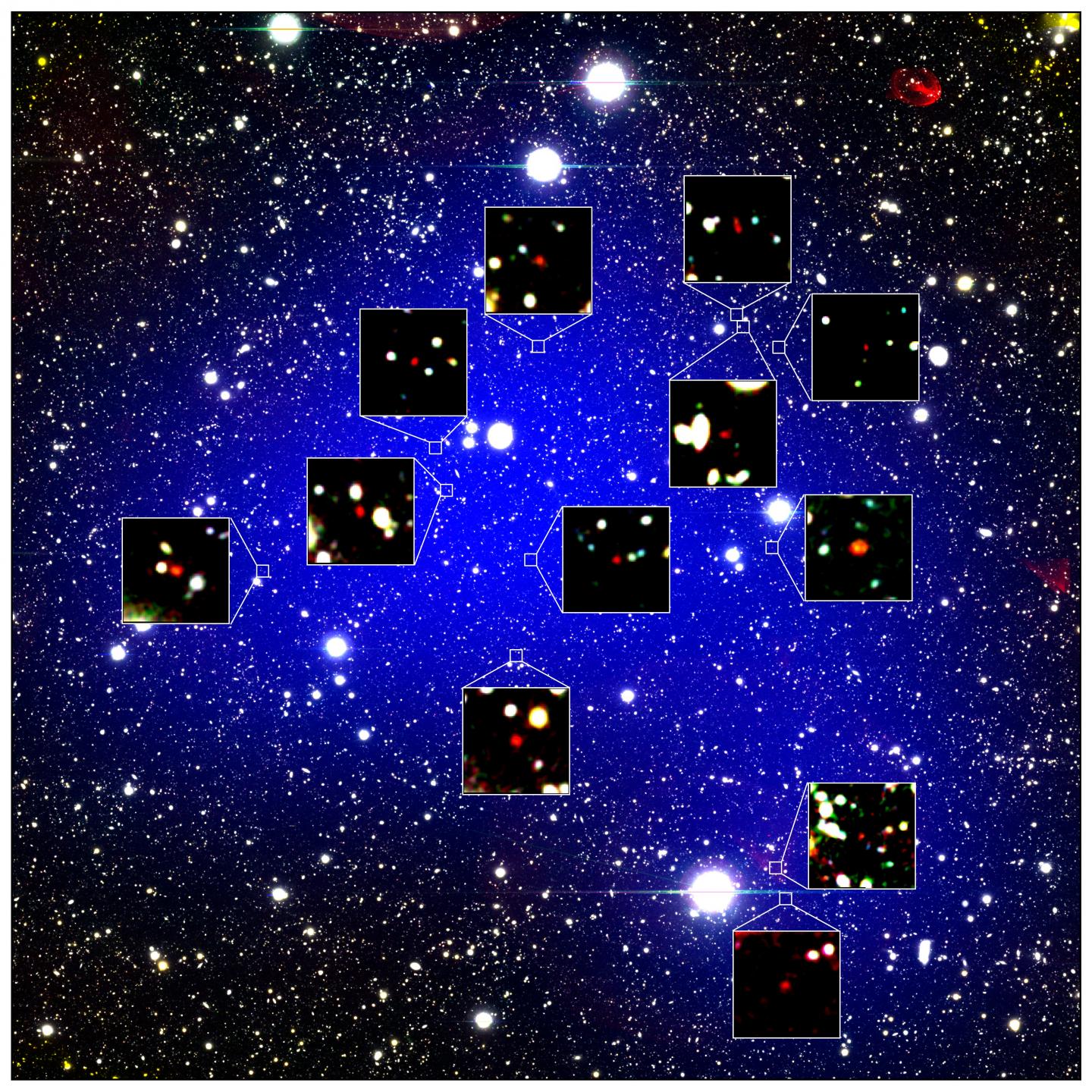
If you could zoom out far enough — hundreds of millions of light-years — the universe would look like foam. Galaxies cluster along filaments and walls. Between them are vast empty regions called voids, some stretching hundreds of millions of light-years across. At the nodes where filaments meet, galaxy clusters accumulate — the most massive gravitationally bound objects in the universe. This is the cosmic web, and it exists because of events that happened a fraction of a second after the Big Bang.
Understanding how structure grows from a hot, nearly uniform plasma to the network of filaments and clusters we observe today is one of the great achievements of modern cosmology. The answer requires dark matter, general relativity, and a connection between the quantum and the cosmic that is remarkable in its precision.
The Seeds: Quantum Fluctuations from Inflation
The early universe was almost perfectly uniform — but not quite. During the inflationary epoch (the exponential expansion in the first 10⁻³² seconds), quantum fluctuations in the inflaton field — tiny random variations in energy density — were stretched from subatomic scales to cosmological ones. These became the seeds of all future structure: regions very slightly denser than average, and regions very slightly less dense.
The amplitude of these fluctuations is characterised by a number called the scalar spectral index (ns). Planck satellite measurements give ns ≈ 0.965 — slightly less than 1, meaning there is slightly more power on large scales than small scales. This "red tilt" is a robust prediction of most inflationary models and its detection confirms that inflation (or something that behaves like it) occurred.
Dark Matter: The Scaffold of Structure
Ordinary (baryonic) matter alone cannot explain the observed large-scale structure. The universe's baryon density is too low, and baryons were coupled to radiation in the early universe — the photon pressure fought against gravitational collapse, preventing baryonic perturbations from growing efficiently before recombination.
Dark matter, which does not interact electromagnetically and is not coupled to radiation, began forming gravitational potential wells immediately after it became non-relativistic — long before recombination. By the time ordinary matter decoupled from radiation at 380,000 years, it fell into the pre-formed dark matter halos. Without dark matter, structure formation would have been far too slow, and the universe today would look nothing like it does.
"The cosmic web is not a random arrangement. It is the direct descendant of quantum noise from the first moments of the universe, amplified by gravity over 13 billion years and traced today in the positions of billions of galaxies. Every void, every filament, every cluster carries information about the physics of the Big Bang."
Enjoying this? Get one article like this every week — free. Subscribe below →
How Structure Grows: Gravitational Instability
After recombination, structure grew by a process called gravitational instability: regions slightly denser than average exerted slightly more gravitational pull, drawing in neighbouring matter. This made them denser still, attracting more matter, in a runaway process slowed only by the expansion of the universe itself.
Initially the overdensities were small and grew linearly — a 1% overdensity grew to 2%, then 3%, at a rate proportional to the scale factor of the universe. Once density contrasts approached and exceeded 1 (roughly 100% overdensity), growth became nonlinear. Regions collapsed, virialised (settled into gravitational equilibrium), and formed the first halos. Smaller halos formed first — this is the bottom-up or hierarchical structure formation paradigm. Small halos merged to form larger ones: first dwarf galaxies, then Milky Way–scale galaxies, then groups, clusters, and superclusters.
Baryon Acoustic Oscillations: A Ruler Frozen in Space
Before recombination, the universe was a plasma in which sound waves — oscillations in the coupled baryon-photon fluid — propagated. These baryon acoustic oscillations (BAO) had a characteristic scale set by how far sound could travel in the 380,000 years before recombination: roughly 150 megaparsecs (about 490 million light-years) in comoving coordinates.
When photons decoupled from baryons at recombination, these oscillations were frozen in place. The characteristic scale was imprinted on both the CMB (as the angular positions of its acoustic peaks) and on the distribution of galaxies (as a slight preference for galaxy pairs separated by ~150 Mpc). This standard ruler — known independently from CMB physics — can be measured in galaxy surveys at different redshifts to track how the universe has expanded, yielding constraints on dark energy and the Hubble constant independent of Type Ia supernovae.
Mapping the Cosmic Web
The existence of large-scale structure was suspected from early galaxy catalogues, but the three-dimensional picture emerged from redshift surveys:
- CfA Redshift Survey (1977–1982): The first suggestion of filamentary structure, including the "Great Wall" — a sheet of galaxies roughly 500 million light-years long.
- 2dF Galaxy Redshift Survey (completed 2003): 220,000 galaxy redshifts revealing the cosmic web clearly: voids, filaments, and the first BAO detection in galaxy data (in 2005).
- Sloan Digital Sky Survey (SDSS, 2000–present): Over 3 million galaxy spectra across a quarter of the sky, producing the largest 3D map of the universe. SDSS has confirmed BAO, measured the growth rate of structure, and revealed structures including the Sloan Great Wall (1.4 billion light-years long).
- Dark Energy Spectroscopic Instrument (DESI, 2021–present): Targeting 40 million galaxy spectra by 2026 to map the universe's expansion history with unprecedented precision. First results in 2024 hinted at possible evolution in the dark energy equation of state — a potential sign of physics beyond the cosmological constant.
- Euclid (launched July 2023): ESA's space-based survey mapping a third of the extragalactic sky to redshift ~2, measuring galaxy shapes (weak lensing) and clustering to constrain dark energy and modified gravity theories.
N-Body Simulations: Making the Universe in a Computer
The theoretical predictions for large-scale structure come primarily from N-body simulations: computational models that track the gravitational interaction of billions of dark matter particles as the universe evolves. Modern simulations like IllustrisTNG and EAGLE also include baryonic physics — gas cooling, star formation, stellar feedback, and active galactic nuclei (AGN) — to produce realistic galaxy populations.
The outputs of these simulations match the observed cosmic web with impressive fidelity. The Millennium Simulation (2005), tracking 10 billion dark matter particles, produced a virtual universe with a filamentary structure almost indistinguishable from observations. Later simulations added more particles, higher resolution, and more complete baryonic physics — but the fundamental concordance with ΛCDM has held at every step.
Open Questions at the Largest Scales
Despite the success of ΛCDM, anomalies persist. The S₈ tension — a discrepancy between the amplitude of matter fluctuations inferred from CMB data and from weak gravitational lensing surveys — is at the 2–3 sigma level and may indicate systematic errors or physics beyond the standard model. The Hubble tension (discussed in our Big Bang article) affects structure formation predictions because the expansion rate sets the growth rate of perturbations.
On the very largest scales, some claimed anomalies — a "Cold Spot" in the CMB that might indicate a supervoid, or the "Axis of Evil" alignment of low multipoles — remain statistically ambiguous. The universe may be statistically isotropic and homogeneous on scales above a few hundred megaparsecs, as ΛCDM predicts, but confirming this requires the next generation of surveys.
DESI, Euclid, the Rubin Observatory Legacy Survey of Space and Time (LSST), and the Roman Space Telescope will collectively map hundreds of millions of galaxies over the next decade. The cosmic web is not a curiosity — it is a precision cosmological tool, and we are just beginning to read it.
How Galaxies Form Within the Web
The cosmic web is not just a backdrop — it is the scaffolding on which galaxies assemble. Galaxy formation is the process by which baryonic matter (ordinary gas) falls into the dark matter halos that formed first, cools, and converts to stars. The environment provided by the web is central to how this process unfolds.
Gas accretion: cold streams and hot halos
Gas reaches galaxies in two modes, depending on halo mass and redshift. In low-mass halos and at high redshift, gas can flow in along cold streams — narrow filaments of cool gas that penetrate the hot halo and reach the central galaxy directly, fuelling rapid star formation. In massive halos (above roughly 10¹² solar masses), infalling gas is shock-heated to the virial temperature — tens of millions of kelvin — forming a hot gaseous halo. This gas must cool before it can form stars, and cooling timescales in the most massive halos are long enough to suppress star formation — a process called hot mode quenching.
Feedback: why stars don't form too fast
Left unchecked, gas in dark matter halos would convert to stars far too efficiently — models without feedback produce galaxies 10× too massive and too old. Two feedback mechanisms dominate:
- Stellar feedback: Supernovae deposit energy and momentum into the surrounding gas, driving galactic winds that eject material from the disc. In low-mass galaxies (dwarf galaxies), these winds can remove most of the baryonic mass. Radiation pressure from young massive stars also disrupts the molecular clouds they form in before the stars have time to form a full stellar population.
- AGN feedback: In massive galaxies, accretion onto the central supermassive black hole drives powerful jets and radiation that heat or expel gas from the halo, suppressing further star formation. This is why the most massive galaxies in the universe — "red and dead" ellipticals — stopped forming stars billions of years ago. The close correlation between black hole mass and galaxy bulge properties (the M-sigma relation) implies a feedback loop between the black hole and the host galaxy during their joint assembly.
Galaxy morphology and the environment
The cosmic web imprints on galaxy properties beyond just mass. Galaxies in dense clusters are predominantly old, elliptical, and gas-poor — quenched by ram pressure stripping (gas removed by the intracluster medium), tidal interactions, and AGN feedback. Galaxies in filaments show intermediate properties. Galaxies in voids — the underdense regions between filaments — are typically gas-rich, blue, star-forming spirals, with relatively little environmental interference. The spin alignment of galaxies also correlates with filament orientation: spiral galaxies tend to spin parallel to their host filament, while ellipticals tend to spin perpendicular. These alignments encode the tidal torquing history of the gas that formed them — a connection between the large-scale tidal field and the small-scale rotation of individual galaxies.
Voids: The Other Half of the Universe
Voids occupy roughly 80% of the universe's volume, yet they contain only a small fraction of its mass. They are not empty — they contain low-density gas, dark matter, and galaxies — but they are profoundly underdense compared to filaments and clusters. They have been studied intensively as cosmological probes in their own right.
Properties of voids
The largest voids in the observed universe extend 100–300 Mpc across. The Boötes Void, identified in 1981, is roughly 250 Mpc in diameter — so large that its existence initially seemed implausible. The KBC Void (the Keenan-Barger-Cowie underdensity), centred on our own Local Group, extends roughly 300 Mpc across and may contribute to the Hubble tension if our local neighbourhood is genuinely underdense relative to the cosmic mean.
Void interiors have distinctive properties:
- Expansion: Voids expand faster than the average universe because the underdense interior has less self-gravity to resist the cosmological expansion. This produces a characteristic pattern of galaxy velocity flows — divergence at the void centre — that can be measured and used to constrain cosmological parameters.
- Integrated Sachs-Wolfe effect: CMB photons passing through large voids lose energy as the gravitational potential well they traverse becomes shallower due to dark energy-driven expansion. This produces a small temperature decrement in the CMB aligned with the void position, detectable statistically by cross-correlating CMB maps with galaxy surveys.
- Galaxy properties in voids: Void galaxies are younger, bluer, and more gas-rich than their counterparts in denser environments. They represent an approximately unperturbed population — galaxies evolving in relative isolation, useful as a control sample for understanding how environment shapes galaxy properties.
Void statistics — their size distribution, abundance, and clustering — are sensitive probes of dark energy, modified gravity, and the sum of neutrino masses. Because voids are in the linear or mildly nonlinear regime, they are easier to model theoretically than clusters. Future surveys will map hundreds of thousands of voids with sufficient statistics to constrain these parameters independently from CMB measurements — providing a powerful cross-check on the standard cosmological model.