Astrophysics · Deep Space
What Is a Black Hole? Event Horizons, Spaghettification, and the Information Paradox
S
Editorial Team
September 19, 2026 · 7 min read
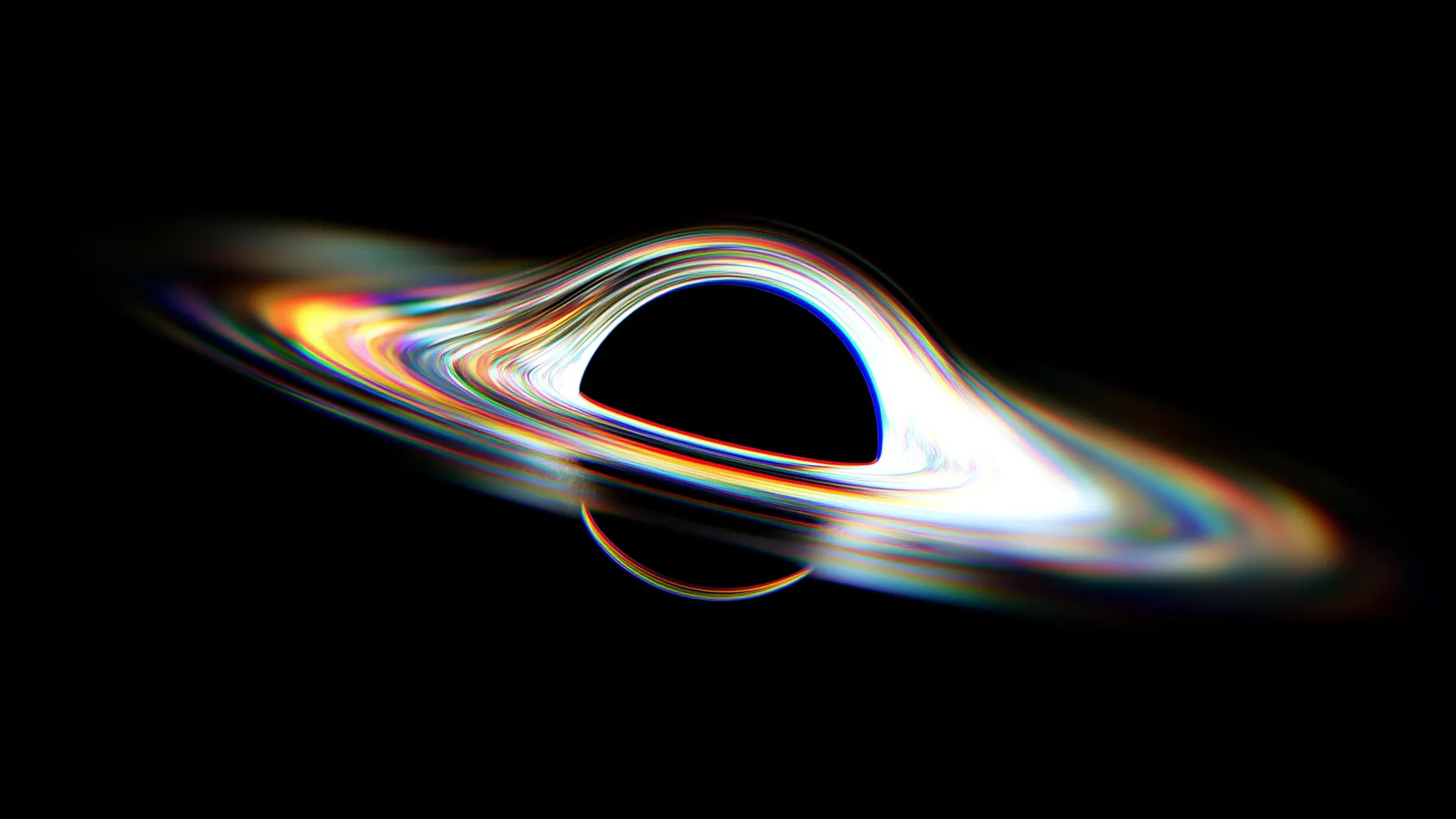
On April 10, 2019, humanity saw a black hole for the first time. The image showed a glowing ring of superheated gas around a dark, empty centre — the shadow of a black hole 6.5 billion times the mass of the Sun, 55 million light-years away in the galaxy M87. The Event Horizon Telescope, a planet-spanning network of radio dishes, had resolved something so extreme that even light cannot escape it. That dark centre is bounded by the event horizon — not a physical surface, but a point of no return: a boundary in spacetime past which the escape velocity exceeds the speed of light, making escape causally impossible.
The event horizon of a non-rotating black hole — described by Karl Schwarzschild's 1916 solution to Einstein's field equations — is defined by the Schwarzschild radius: rs = 2GM/c², where G is the gravitational constant, M is the mass, and c is the speed of light. For the Sun, that radius is about 3 kilometres. The Sun is not a black hole; it would have to be compressed to 3 km across before it would become one. For Earth, the Schwarzschild radius is roughly 9 millimetres.
"The event horizon is not a thing you pass through dramatically — it is a point from which the future only leads inward. From the outside, you would never see someone cross it; their image would redshift and freeze at the horizon forever."
What Happens If You Fall In
From the perspective of someone falling into a stellar-mass black hole, the event horizon would not feel special when crossed — at least not immediately. General relativity predicts that for a sufficiently massive black hole (supermassive, like the ones at galactic centres), you could cross the horizon without noticing any dramatic effect. Locally, spacetime is smooth.
What you would notice, as you fell deeper, is tidal forces. These are not unique to black holes — the Moon's gravity raises tides on Earth through the same mechanism — but near a black hole they become lethal. Gravity is stronger at your feet (closer to the centre) than at your head. That difference stretches you lengthwise and compresses you sideways, a process physicists call spaghettification.
The effect is real physics, not science fiction. The tidal acceleration across a body of length l at distance r from a mass M scales as roughly 2GMl/r³. For a stellar-mass black hole (say, 10 solar masses), the tidal force at the event horizon is strong enough to tear apart atoms. For a supermassive black hole of billions of solar masses, the tidal force at the horizon is actually quite gentle — the horizon is so far from the singularity that the gradient is modest.
Enjoying this? Get one article like this every week — free. Subscribe below →
How We Know Black Holes Are Real
For most of the twentieth century, black holes were a mathematical prediction without direct evidence. That changed dramatically in recent decades. There are now multiple independent lines of evidence:
Stellar Orbits at the Galactic Centre
- Sgr A* (Sagittarius A-star): Astronomers at the Max Planck Institute (led by Reinhard Genzel) and UCLA (led by Andrea Ghez) tracked individual stars orbiting the centre of our Milky Way. Star S2 completes an orbit every 16 years, reaching speeds of nearly 3% the speed of light at its closest approach. The mass enclosed must exceed 4 million solar masses concentrated in a region smaller than our solar system. Genzel and Ghez shared the 2020 Nobel Prize in Physics for this work.
- In 2022, the Event Horizon Telescope (EHT) collaboration released the first direct image of Sgr A* — a glowing ring of radio-wavelength emission surrounding a dark central region the size of the predicted event horizon.
Gravitational Wave Detections
- On September 14, 2015, the LIGO detectors registered GW150914 — two black holes of roughly 29 and 36 solar masses spiralling together and merging 1.3 billion light-years away. Since then, the LIGO–Virgo–KAGRA network has detected dozens of binary black hole mergers.
The First Image: M87*
- In April 2019, the EHT released the first-ever image of a black hole shadow — M87*, containing about 6.5 billion solar masses, at a distance of 55 million light-years. The image shows a bright asymmetric ring consistent with relativistic beaming from plasma orbiting at a large fraction of the speed of light.
The Information Paradox — An Open Question
In 1974, Stephen Hawking showed that black holes are not entirely black. Quantum mechanical effects near the event horizon cause black holes to emit thermal radiation — now called Hawking radiation — with a temperature inversely proportional to the black hole's mass. This has profound consequences.
If Hawking radiation is purely thermal — carrying no information about what fell in — then when a black hole eventually evaporates, the information about every particle that ever fell into it is simply gone. This would violate a foundational principle of quantum mechanics: that physical processes are reversible and information is never destroyed.
This is the black hole information paradox, and it remains one of the deepest unresolved problems in theoretical physics. Current candidates for its resolution include:
- Hawking radiation carries subtle correlations — not truly thermal but encoding information about infalling matter. Favoured by most quantum gravity researchers, following insights from AdS/CFT.
- Firewalls — a 2012 proposal by Almheiri, Marolf, Polchinski, and Sully suggesting the event horizon is a "firewall" of high-energy radiation, violating the equivalence principle.
- Black hole complementarity — two contradictory descriptions are both valid but can never be compared.
None of these resolutions is universally accepted. The paradox sits at the intersection of quantum mechanics and general relativity — exactly the domain where we lack a complete theory. It is genuinely open.
Types of Black Holes
Not all black holes are alike. Astronomers have identified three broad classes, spanning twelve orders of magnitude in mass:
Stellar-mass black holes (3–100 solar masses)
These form from the collapse of massive stars and from compact binary mergers. They are the most common type and the ones LIGO and Virgo detect. The first confirmed stellar-mass black hole, Cygnus X-1, was identified in 1971 through its X-ray emission as it drew matter from a companion star. LIGO's first detection in 2015 — GW150914 — came from two stellar-mass black holes of roughly 29 and 36 solar masses merging 1.3 billion light-years away, producing a final black hole of about 62 solar masses. The missing 3 solar masses were radiated away as gravitational waves in a fraction of a second, briefly outshining the entire observable universe in gravitational wave power.
Intermediate-mass black holes (100–100,000 solar masses)
This class is the least well established. Candidates include some ultraluminous X-ray sources and possibly the centres of dense globular clusters. In 2020, LIGO and Virgo detected GW190521 — a merger producing a final black hole of roughly 142 solar masses, the first direct evidence of an intermediate-mass black hole formed from a compact binary coalescence. How these form is not settled: repeated mergers, direct collapse of massive Population III stars, and runaway stellar collisions in dense clusters are all candidates.
Supermassive black holes (millions to tens of billions of solar masses)
Nearly every large galaxy appears to host a supermassive black hole at its centre. The Milky Way's, Sgr A*, has a mass of about 4 million solar masses. M87's central black hole — the subject of the first Event Horizon Telescope image in 2019 — has a mass of 6.5 billion solar masses. TON 618, a quasar 10.4 billion light-years away, harbours a black hole estimated at 66 billion solar masses. How these giants formed in the early universe — whether from seeds left by Population III stars, from direct collapse of massive gas clouds, or from repeated mergers — is an open and active area of research.
- Active galactic nuclei (AGN): When a supermassive black hole is actively accreting, it can outshine its host galaxy. Quasars are the most luminous persistent objects in the universe — the brightest have luminosities exceeding 10¹⁴ times the Sun. Jets of plasma, accelerated to near-lightspeed, can extend for millions of light-years.
- Dormant black holes: Most central black holes, including Sgr A*, are currently inactive — their accretion rates are low. Sgr A* shows occasional X-ray flares but is otherwise quiet compared to historical AGN phases inferred from surrounding gas structures.
Hawking Radiation: Black Holes Are Not Eternal
In 1974, Stephen Hawking showed that black holes are not entirely black. Combining general relativity with quantum field theory in curved spacetime, he derived that black holes should emit thermal radiation — now called Hawking radiation — with a temperature inversely proportional to their mass:
T = ℏc³ / (8πGMkB)
For a solar-mass black hole, this temperature is about 60 nanokelvins — far below the 2.725 K cosmic microwave background, making detection impossible in practice. For a black hole to be hot enough to radiate noticeably, it would need to have a mass comparable to a mountain compressed to a subatomic scale.
As Hawking radiation carries away energy, the black hole slowly loses mass. The process accelerates as the black hole shrinks: smaller mass means higher temperature means more intense radiation. In the final moments, the remnant evaporates in a burst of high-energy particles. For a stellar-mass black hole, this process takes on the order of 10⁶⁷ years — far longer than the current age of the universe. For a primordial black hole of a billion tonnes (if any exist), the timescale is comparable to the current universe age, meaning such objects could be evaporating now.
Hawking radiation has not been directly detected. Its observation would require either a primordial black hole in its final stages, a controlled analogue experiment (sonic black holes in Bose-Einstein condensates have shown analogous effects), or future technology far beyond what exists today. Despite this, the theoretical prediction is taken seriously — it follows from well-established physics applied to the black hole geometry, and its consequences (particularly for the information paradox) are central to the deepest unresolved problems in fundamental physics.